Awww geeze, not another blog!


Welcome to A Fine Blade!

This blog will focus one of my lifelong passions and one of man's most basic tools - the knife!

As time and events permit we'll tiptoe into other territory where we can use the knife as a metaphor in discussions about current events and have a little politically incorrect fun.

Because you see, knives rank just below guns as the most politically incorrect subject on the web today.

Guns & Knives = Bad. Gay Marriage & Recreational Drug Use = Good

We'll see if we can't have some fun with that.

So stay tuned, and welcome aboard!

Sunday, April 22, 2012

Everything Old is New Again

When I first got serious about knives and knife collecting as a teenager back in the 70s (or as my kids refer to it, 'the early Middle Ages') and could afford some of the knife publications just starting to become available - both magazines and books - it was immediately clear to me that the knife world was in the midst of a paradigm shift.

Plain old carbon steel - the stuff of which knives had been made for over 100 years and had served man well - was on the way out.  Carbon steel was viewed as old school, good in its day but its day was drawing to a close.  The new thing, the thing that was was the future of knife making in the US, was stainless steel.

Stainless steel wasn't really new.  It had first been commercially developed in the early part of the 20th century (by the Germans, naturally).  The first formulations were pretty simple.  It was little more than ordinary carbon steel with a bit of chromium added to the mix to discourage corrosion.  The problem was that the proper mix of rust-inhibiting additives was not well understood and the heat treating and tempering requirements were not well worked out.  The early attempts to make high strength cutlery steel out of the first generations of stainless failed because the steel wouldn't take a temper and knife blades ended up being either too soft or too brittle for use.  For some applications this poor tempering (and resulting poor edge holding ability) was overlooked.  For example, knives designed for use by salvage divers were commonly fashioned out of this early stainless steel.  In this application corrosion resistance was deemed more important than edge holding ability.

Two world wars and a world-wide depression tamped down any demand for quality stainless steel knife blades.  Then after WWII there was an explosion in metallurgy research and development driven primarily by the development of jet engines.  Suddenly high strength stainless alloys were needed, and needed now!  Jet turbine fan blades required stainless alloys that were easy to machine into complex shapes and retain strength and toughness under the high stress operating conditions found in a jet engine.

The knife industry got a lot of benefit from all this R&D.  It was not just the development of new stainless steels, but a growing understanding within the knife industry of the unique heat treating and tempering requirements for all types of steel, high carbon and stainless.  Before WWII heat treating and tempering was viewed as something of a black art among knife makers.  After WWII knife makers started getting smart on metallurgy and adopted the modern techniques and tools of the steel industry.  Consistency and quality went up.  Heat treating and tempering was no longer an art.  It was a well understood science.  Before long the better knife makers realized that stainless steel is just another type of steel with its own well documented heat treating and tempering requirements.  There was no reason to not give it a try.

Almost overnight knife makers were turning out high quality knives using stainless steel, most using one or more of the 400-series steels.  These blades seemed to have it all - they were relatively easy to machine or grind (hand forging stainless was still an iffy endeavor, so most knife makers adopted the simpler stock removal method of forming blade shapes), they took a good heat treat and temper, were easy to sharpen in the field and they didn't corrode.  It seems everybody wanted a knife with a stainless steel blade, particularly one made of 440C, the 'it girl' of knife steels.

Still, many of the custom knife makers grumbled.  Good old high carbon steel, particularly the 10xx-series steels like 1075 and 1095, still made great knives.  High carbon steel was easier to forge, grind and heat treat, it took a better temper, it polished easier (it is tough to get a true mirror polish on many stainless steels) and overall made a tougher, more resilient blade.  But carbon steel was yesterday's steel.  The new generations of outdoorsmen wanted stainless.  The demand for carbon steel blades fell off sharply and some large manufacturers stopped using it all together.

A Buck Model 102 with an Orangewood handle.
Buck was an early adopter of stainless steel for knife production
and today makes most of its blades using 420C stainless.
Fast forward about a quarter century and I'm once again deep into knife collecting.  Although I continued accumulating knives during this time I never really kept up in industry trends.  Imagine my surprise at finding out that stainless steel is now passe' and that good old high carbon steel is the new 'it girl' in knife making.  It was like Rip van Winkle waking up from a 25 year nap.

What happened?  Did stainless steel somehow fail the knife user community?  No, not at all.  In fact, in the intervening decades steel manufacturers continued to develop new stainless steels that are ideal for knife making.  Along with the 400-series steels we also got 154CM, S30V, AUS-8 and others, all excellent knife steels.  At the same time carbon steel technology didn't move forward as much, perhaps a reflection of the already mature nature of high carbon steel formulations going back to the 1940s.

What really happened is what happens with most consumer goods - tastes change.  Knife buyers embraced stainless steel (and still do) but after a fashion they started to look for something different, something nostalgic.  Many started looking back at the knives their fathers and grandfathers carried, knives with names like Case, Ka-Bar, Camillus, Remington and Schrade stamped on the blades. 

High carbon steel does have one significant drawback.  It rusts.


However, even decades of corrosion can be dealt with and a good knife quickly
returned to working status.  This is a Utica Cutlery 'Kutmaster' Girl Scout
knife that sat in a box in a closet for about 30 years before my wife (the
original owner) found it.

In the 1970s those names were old, stodgy.  About as modern as a Ford Model A.  Those companies made their products out of plain-jane high carbon steel and, it seemed, they hadn't had an innovative idea in decades (pretty much true, by the way).

Fast forward to the dawn of the 21st century and suddenly high carbon steel isn't 'plain-jane', it's 'trusted', 'proven' and 'tested'.  High carbon steel blades are all the rage, and manufacturers and individual knife makers can't turn them out fast enough.  Knife collectors and users are talking about old formulations like 1095 in almost mystical terms, as though any blade fashioned out of the steel is imbued with Excalibur-like qualities.  Customers are ringing up custom knife makers and saying "I want a knife made out of real steel, not some fancy high tech stainless mish-mash."  Buyers are actively choosing to have high end custom knives made out of regular old high carbon steel.  Why?  Because they can!  And more so, because high carbon steel makes one hell of a fine knife blade.

Stay sharp!

Brian

Tuesday, April 10, 2012

Blade Of The Month - Gerber A400

There was a time when Gerber Legendary Blades actually made legendary blades.  Up until the mid-1980s Gerber made some of the finest production knives in the world.  Their quality and innovation was top-tier and they were a leader in the industry.  Whereas Buck was viewed as kind of a stodgy battleship of a knife company that hadn't had an original thought in decades, Gerber forged ahead with outstanding designs, unique partnerships with leading knife designers like Blackie Collins and Paul Poehlmann, and always outstanding production quality.

Then in 1987 Pete Gerber sold the company to Fiskars and everything went to crap.  Innovation and quality slid downhill and Gerber became just another purveyor of boring cutlery.  Over time their designs became about as exciting as a 1960 Ford Falcon.  I never heard just why Gerber decided to sell out.  Perhaps the money was just too good.  Now, I'm not saying that the post-Gerber ownership products were/are bad products.  For the most part they are good quality working knives.  But they are boring, uninspiring and soul-less.

But before 1987, oh what wonderful knives they made!  Today we'll look at one of those pre-1987 knives, and one of my favorites.

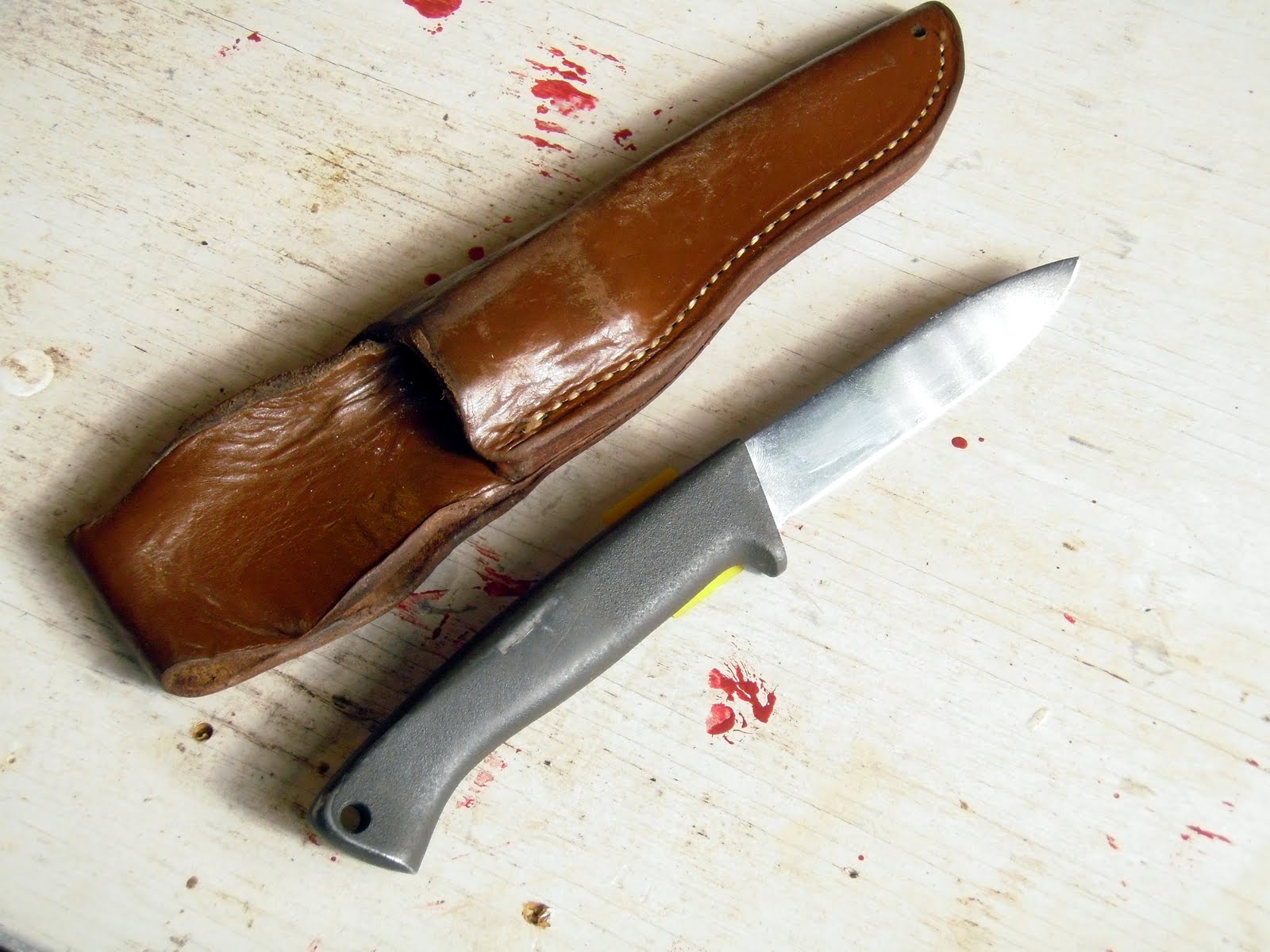
The Gerber A400 drop point hunter:


If memory serves I bought this new at a gun show in Toledo around 1977.  It's had a short but hard service life, and all the wear and tear you see on it and the sheath is my doing.  In 1979 I went on active duty in the Army and carried this on my pistol belt for a year or two.  That accounts for most of the scuffs, scrapes and the overall lousy condition of the sheath.

The design of the A400 is an extension of Gerber's original knife design.  Gerber began makng knives in 1939 and developed a production method involving the use of tool steel blades that were hard chromed for corrosion resistance and had cast aluminum handles.  The first Gerber knives of this design were kitchen cutlery sets, but Gerber soon branched out into outdoor knives using the same basic design.

What makes this knife and other Gerbers like it is the excellent overall quality.  The blades is beautifully ground and carries a brushed chrome finish.  The handle is expertly shaped and extremely comfortable.  The sheath is an integral part of the package, and Gerber made some of the best leather sheaths in the industry.  Featuring a pouch design that is tightly fitted to the knife, it is made of high grade leather that was expertly stitched and includes touches like a steel reinforcing section at the tip to prevent the knife tip from piercing the leather.  Today it's hard to find custom knife makers offering sheaths this good, let alone a production knife.

I have read that these knives were fairly expensive to produce.  The steel sat at the very high end of the hardness scale for a knife - around 62 on the Rockwell scale - and they wore out the grinding and polishing wheels at the factory at about twice the rate of softer blades.  They were also tough to sharpen, but they had a reputation for holding an edge a long, long time.  My experience supports this - I don't think I've had to touch up the edge on this knife more than two or three times. 

The A300 is long gone out of Gerber/Fiskars' catalog.  Today we get Chinese made junk like the Bear Grylls knife.  Sad.

Stay sharp!

Brian


Friday, April 6, 2012

The Worst Knife In My Collection

OK, maybe not the worst knife, but certainly the knife that is the least useful based on design, weight and ergonomics.  That honor goes to (drum roll please)...

The Buck 184 'SEAL knife'!


A funny conclusion this, because if there is one knife that most Buck aficionados say they must have in their collection it is the Buck 184.  I'm no exception.  The 184 is a 'must have' blade if you are at all serious about collecting Buck knives.  It occupies a very unique position in the history of Buck knife production.  However, it is a blade that really has no practical use in the real world.  Although it is extremely well designed and executed (and is perhaps one of the best hollow handled knives ever produced in large numbers), it is a purpose built device designed to fit a narrow range of tasks.  As the name indicates, the 184 was designed to meet a specific requirement statement from Naval Special Warfare Command, or the SEALs.  The 184 has a fascinating history which is well documented at the www.buck-184.com website so I won't delve into it here.

However, this particular knife has a provenance.  I've owned it since early 1989.  In February of '89 I was leading a geographic analysis team in Honduras as part of Task Force Tiger out of the 20th Engineer Brigade from Fort Bragg, NC.  One of my NCOs was a surveyor named Mike Finley.  Mike showed up with this knife dangling off of his belt.  I'd never seen one in the flesh before and thought it was a really neat design.  Mike had not babied it - the knife looked in 1989 about the same as it does in the picture above.  He had lost one of the anchor pins and virtually all the survival items that came in the sheath pouches, but the knife itself was still in good shape.  I told Mike that if he ever considered selling it to let me know and I'd give him a fair price for it.

About a week later we were sitting across from each other in a C-130, heading for a parachute jump in southern Honduras.  Before deploying for Honduras I had purchased one of the first Casio altimeter watches sold in the PX at Fort Bragg.  Before the plane took off  I was sitting in my seat playing with the settings so I could monitor the C-130's altitude just before the jump (we always suspected the pilots came in a bit too low on our jumps).  I wasn't particularly impressed with the watch.  It only provided altitude readouts in meters and I was planning on replacing it when we got back to Fort Bragg.  Mike, however, became fascinated by it.  I let him play with it during the short flight to the drop zone and he thought it was the coolest thing he'd ever seen.

Back in camp after the jump Mike came up to me and asked if I'd be interested in doing a straight trade - my watch for his knife.  I hesitated.  I knew his knife was worth much more than the watch and I told him so.  Mike didn't care.  He told me he was never much impressed with the knife and he really wanted the watch.  We did the trade.

The first thing about this knife that got my attention is that it is heavy.  I mean, pull you straight to the bottom of the pool heavy.  The knife and sheath combo seemed like they weighed at least three pounds.  I know I'm exaggerating, but not by much.  The blade is too big for anything other than chopping down trees or prying your way out of an armored personnel carrier.  In other words, it is a neat design, but it's just too big and heavy to be practical.

I carried the knife for a few weeks in Honduras and when I got home to Fort Bragg I re-profiled the edge, but never used it much after that.  It soon joined the small collection of knives I was accumulating in an old duffle bag and I went out and bought a Randall Model 14 (another story for another time).  Still, I never regret trading Mike for this knife.  It's value has only gone up while I'm sure that Casio watch went into the trash a decade or two ago.

Sunday, April 1, 2012

A Watch Review

When I'm not collecting knives, backpacks, fly rods or (lately) canoes I can often be seen haunting the wristwatch offerings on Amazon.  I have always been fascinated by watches and time pieces.  Down through the years I've owned dozens of watches and I've got about nine or more in my current collection.  Some watches are a reflection of my fascination with precision and accuracy.  These tend to be things like Casio digital models that automatically sync with the atomic time signals out of Fort Collins.  Others tend to reflect my love of mechanical watches, mainly Seiko diver models.  I'm not yet rich enough to afford a Rolex or Omega, and probably never will be, so I satisfy me urge for watches that go 'tick-tick' with good quality but lower end mechanical pieces.

My first love has always been the traditional watch - one with moving hands.  However, it has always been hard to find a watch that fit my three main criteria - accurate to within a few seconds each day, rugged and waterproof enough to swim with and cheap enough (sub-$200) for me to afford.  Finding watches that fit any two of these criteria was easy enough, but finding watches that fit all three was tough.  Seiko diver watches are rugged, waterproof and inexpensive, but to be kind their accuracy isn't all that great.  Mine gain or lose up to a minute a day.  I wanted something accurate enough for celestial navigation.

About 18 months ago I stumbled on the Luminox line of watches.  These watches gained fame as the 'offical Navy SEAL watch', though I think that claim was more marketing hype than anything else.  It seems any company that gets a purchase order from the Naval Special Warfare Command claims it's product is 'Offical Navy SEAL' whether it's ball point pens or attack helicopters.  Marketing hype aside, these watches got very good reviews; users found them accurate, rugged and lightweight.  The watches use battery powered Swiss movements and are rated waterproof to a depth of 200 meters.  The only thing thing that irked the traditionalist in me is that the cases are made of a polycarbonate composite.  I kinda' like my wrist watches made of metal.  But still, for a shade under $200 (street price) I was willing to take a chance.

Luninox made it's reputation (and based it's name) on the fact that it uses tritium gas illumination vials in all of it's watches.  These tiny vials, placed on the watch hands and hour indicators, supposedly make the watches very easy to use at night.  The vials don't light up the whole watch face, they just provide clear points of light for visual reference.

So early last year I ordered up one of the Luminox 3000-series watches.  This is the 'original' Navy SEAL model and one of the least expensive in the Luminox line, it's base model so to speak.  It sports an easy to read black face with roman numerals, a date indicator and a rotating bezel.   Two things immediately struck me - it is a small watch by dive watch standards.  Compared to a Seiko dive watch the Luminox is diminutive.  It is also light, very light.  Again, compared to a Seiko diver with it's huge self-winding mechanical movement this watch is feather light.

A few other things that quickly struck me about this watch.  It is attractive in a no-nonsense utilitarian sense - everything you need to tell time quickly and accurately is right there in front of you; no button pushing like on a Casio or other digital watch.  The rotating bezel is well laid out and has strong, positive click stops.  The movement is a 'hacking' movement, which means that when you pull out the winding stem to set the time the second hand stops.  This makes this watch very easy to sync with other watches, and I routinely set it against my atomic clocks, to the second, using this feature.  And last, the tritium illumination makes this the best nighttime use watch I've ever owned, period.  The tritium gas vials are placed on the watch hands (even the second hand) and at all the hour indicators.  Since tritium gas is self-illuminating there is no requirement to expose the watch to light to get the thing to glow.  The tritium illumination is constant, never dimming through the night as the phosphorescent paint used on most other watches does.  A quick glance at the watch face under any lighting conditions - full noonday sun or a pitch black room - and you know immediately what time it is.

The only drawback to the watch is the band.  It is a fairly cheap rubbery strap.  I figured this watch deserved better so I ordered up a one-piece nylon Zulu band from Countycomm.  I also thought the watch would look good accompanied by a wrist compass, so I ordered up a small watch band compass from Brigade Quartermasters.  I've been using these small wrist compasses for 20 years and consider them to be the best quality watch band compass available.  They are made in Japan and are very high quality.  Of course they do take a beating sitting on your wrist next to the watch, but for less than $10.00 they are cheap to replace when they develop a bubble or the face gets too scratched up to view clearly.

Here's the whole package.


Neat, compact and extremely useful.

Over the course of the year this watch has lived up to it's reputation.  It's been dunked innumerable times on fishing and boating trips, been exposed to freezing cold and the baking, humid heat of Georgia summers.  It's been banged into car doors, dropped on floors and at one point thrown at a dog that wouldn't stop barking at the cat.  Over time the polycarbonate casing has received some scars but the mineral crystal face has, surprisingly, remained scratch free.

Most impressive, however, is that this watch remains consistently accurate to within 3 seconds per day as measured against my atomic clock.  Three seconds per day.  Now, for a mechanical watch movement to receive a 'chronometer' certification from the Swiss testing authorities it only needs to be accurate to within 15 seconds per day.  I'm not implying that this watch is the same quality as a Rolex or Omega, but a sub-$200 watch holding that level of accuracy is extremely impressive.

So consider this a long term review.  The Luminox 3000-series watches are impressive.  Hmmm, I see Amazon has the orange face model on sale now....

Tuesday, January 31, 2012

Why I Don't Like Zippers

In my last post I just casually mentioned that I'm not a big fan of clamshell-design packs because they rely almost wholly on a zipper to hold the contents in the bag.  Zippers are mechanical devices that can, and will, fail.  I actually got a few off-blog comments about my statement, telling me I'm being overly alarmist about the whole issue.  Maybe so.

But then again, maybe not:


I grabbed this picture off of an eBay auction this morning.  This is a USMC ILBE 3-day assault pack.  These are extremely well made bags, produced by Arc'Teryx for the Marines and they fill the same general role as the MOLLE II Assault Pack I discussed earlier.

The seller in this auction has 10 in this condition he wants to get rid of, so it looks like this zipper failure is not an isolated incident.  He's very up front about the condition, so there are no deceptive auction practices at work here.

Statistically these kinds of failures are probably very low.  One thing is for certain, however - you'll never see a failure like this on a top loading bag like the ALICE pack.

Brian

Saturday, January 14, 2012

Bag It

Let's switch gears for a minute or two and talk about something other than knives.  I like to hike.  Always have.  As a teenager my friends and I would tromp all over southern New Jersey in a quest to identify all the abandoned towns that once filled the vast empty spaces of the Pine Barrens region of that state.  When I moved to Ohio in my mid-teens I found myself hiking up and down the Maumee River Valley following the traces described in Allen Eckert's classic works about the hardy frontiersmen that opened and settled the original Northwest Territory.

While I did very little overnight backpacking I would easily wear out a pair of hiking boots each season tromping the local trails and roads.

Along the way I developed a strong interest in - some would say an obsession with - the bric-a-brac of outdoor life and adventure.  This accounts for my fascination with knives.  I also developed a slightly weird fascination with backpacks.  I think it started with my realization that the old, square canvas Boy Scout knapsacks we used as kids were, well, let's be honest here - they were simply lousy load carrying devices.  It took this lowly and somewhat dim Tenderfoot only about two outings to realize there had to be something better out there.

This was about the time the lightweight backpacking craze was sweeping America, fueled in large part by Colin Fletcher's classic bible of backpacking, 'The Complete Walker'.  The pages of of the outdoor magazines were filled with sexy shots of hikers on the Appalachian Trail or the Pacific Crest Trail sporting the latest in load carrying technology from companies like Kelty or JanSport.  These newfangled aluminum and nylon concoctions were a bit more than I needed for schlepping the local trails.  A lot of them made you look like you were hauling a refrigerator on your back, but they showed the way to the future.

Then one rainy Saturday afternoon I caught the movie 'The Mountain' with Spencer Tracy and Robert Wagner.  Set in the French Alps, it's the story of two brothers who climb a mountain to reach a plane crash site and plunder the belongings of the crash victims.  This was the first and only time I've seen the movie.  While I remember the story line as being somewhat interesting what really caught my eye were the backpacks they used in the climbing scenes. These were the classic teardrop-shaped Alpine style rucksacks.  I was fascinated by them - so those are what serious climbers use!  They are soooo cool!  The image was burned into my memory and launched me on a lifetime quest to find the perfect rucksack, just like the one Spencer Tracy used in the movie.


It's been a long, enjoyable and slightly frustrating quest, and I've come to realize that the perfect and perfectly cool Alpine rucksack like they used in the movie simply doesn't exist.  Or at least I haven't been able to find it after decades of searching.  No matter, I've found plenty of great substitutes along the way.

In this and subsequent posts we'll have a look at some of the rucksacks I've come across and why they work (or don't work).  I've had a lot of rucksacks on my back over the years, and I've lived out of them for weeks (and in one case months) at a time.  Most of this experience has been with the US Army's ALICE system rucksack (which we'll tackle in a later post).  But living with and depending on a piece of gear for so long gives you a good perspective as to what works and what doesn't.  Now it takes me about three minutes wearing a pack under load to determine if that particular bag is good or bad (for me).  What counts is comfort (always the #1 consideration), ruggedness, good design and execution.  Surprisingly weight becomes a secondary consideration; ruggedness and quality of execution impose their own weight requirements.  

Let's start with my current favorite, and it's a design I'm fairly new to.  In the 1980s the Army realized that the old ALICE (All-purpose Lightweight Individual Carrying Equipment) system was badly outdated and a new Soldier load carrying system was needed.  This triggered a complete rethinking of military load carrying technology and out of it came the MOLLE system (MOdular Lightweight Load carrying Equipment).  The MOLLE system went into general issue with the Army in the early 2000's at about the time I retired.  The system is in its second generation (MOLLE II) and may be headed to a third generation upgrade.  As the name indicates, the system is designed to be modular.  The MOLLE system consists of external frame packs of different sizes, rucksacks, pouches and bags all of which can clip or snap together in various configurations. Soldiers can combine different components of the MOLLE system depending on specific mission requirements.

As was bound to happen, soon after adoption MOLLE equipment began to leak out into the civilian market.  Some of this was from Soldiers selling their field gear after they left the service, some was from contract over-runs by the manufacturers and some was surplus releases of used equipment by the US military.  The one MOLLE component that quickly became a hit with civilian users is the MOLLE II Assault Pack (NSN  8465-01-524-0001).

MOLLE II Assault Pack front view

The Assault Pack is what civilians would classify as a large day pack.  It's a common design - a half clamshell secured by a large zipper, with load compression straps on the side and a large exterior pouch.  Where the Assault Pack shines is in the details.  Because it was designed to be worn over body armor the shoulder straps are very generous and well positioned for a guy with my body type (that's a polite way of saying I'm overweight).  The pack also incorporates an internal plastic stiffener that provides shape to the pack and shields the wearer's back from poking and prodding by items inside the pack.  The pack is manufactured of heavy nylon and all seams are taped and double stitched.  Stress points are all reinforced.  There are plenty of external straps and attachment points for mounting pouches or other do-dads.

MOLLE II Assault Pack rear view.  That is a GPS receiver pouch
mounted on the right strap, a wrist compass on the left.
The Assault Pack is not the lightest thing available; empty and with no external pouches it weighs in at about 3 lbs.  However, as I mentioned the pack is extremely rugged and made out of heavy nylon.  It's a trade-off - additional weight for durability.  It's a trade-off I'm willing to make.

Where the Assault Pack really shines is carry comfort.  This is perhaps the most comfortable large day pack pack I've ever used.  I routinely load this pack up to about 23 lbs (water, first aid kit, jacket, GPS receiver, maps, binoculars, survival kit, knife and other small items).  It's a full load, but a comfortable load.  The shoulder straps look thin in profile but the design does a very good job of distributing the load.  The shoulder strap design means the straps stay in place regardless of what you are wearing.  There is enough adjusting strap length that it's easy to loosen the shoulder straps wide, toss the bag onto your back and roll your shoulders while tugging on the straps to get a perfect fit.  The internal stiffener allows the pack to rest comfortably against your back and keeps the loads from shifting around.

Other small details add to the usefulness of this pack.  You can use it with a hydration bladder and there are covered drinking tube openings on each side of the drag handle (although these openings are not really there for use with a drinking tube - more on that in just a bit).  Each shoulder strap has a 'dump' buckle - unsnap the buckle cover (think of it as a safety) and pull up on the web tab and the shoulder strap and adjusting strap separate.  The zippers are the heaviest YKK self-repairing nylon zippers I've ever seen and the Fastex-type buckles that secure all the webbing are heavy duty.

This pack is designed for use on parachute jumps and it comes with stitched-in webbing for attaching to a parachute harness.  This is really what the two 'drinking tube' flaps on each side of the drag handle are for.  You route the straps out from the inside of the pack through these slits.  There is also a lowering line attachment loop sewn into the bag.

There are some quibbles, but they are minor.  The bottom of the bag is not reinforced.  Some double layered protection would have been nice.  I have to be fair, though, and mention that the bottom of my ALICE rucksack that saw me through over 12 years of service didn't have a reinforced bottom and it survived just fine.

I'm also not a big fan of clamshell design packs.  Zippers can fail, and when they do there go the contents of your pack.  The Assault Pack mitigates this somewhat by being only a half clamshell design and the compression straps help take the strain off of the zipper.  Clamshell designs are also not very waterproof.  In fact, they leak like a sieve.  The main pouch zipper has only a small, thin weather flap covering it.  This isn't a pack designed for use in wet weather.  I much prefer a top-loading design with a cover flap.

In general I'm not a big fan of the clamshell design.  If the zipper fails there
goes the contents of the bag.  The Assault Pack mitigates this somewhat by
being only a half clamshell design, using a very stout YKK zipper and
placing compression straps where they can take some of the strain off of
the zipper.  Note the white plastic stiffener and the white parachute harness
webbing at the top of the picture. 

And then there's the camouflage pattern.  Most of the packs coming onto the market today are made with the Army's ACU digital camo pattern (also known as the Universal Camouflage Pattern).  This pattern has served the Army well through almost 10 years of war in the Middle East, but it is really too light for effective use in more vegetated regions.  This pattern, especially after it starts to fade a bit, really stands out in the forests of North America.  I'd much prefer olive drab, but you take what you can get.

Speaking of camouflage patterns, the Army produced this pack in the old woodland (BDU) pattern, the desert (DCU) pattern, of course the ACU pattern, and is now making them in the new Army MultiCam pattern.  Since so few were made in the woodland and desert pattern they are harder to find and good examples command relatively higher prices.  The new MultiCam patterned bags are just starting to appear and they command outrageous prices - I saw one go on eBay in the last few weeks for about $150.

But right now the ACU pattern Assault Pack can be found at bargain prices.  There's always examples for sale on eBay and internet storefronts like Uncle Sam's Retail Outlet are selling them new for as low as $59.99. That's one heck of a deal for a great bag that costs the real Uncle Sam something close to $90.


The detachable multi-purpose pouch, designed originally
to hold the Army 1qt canteen, does a fine job holding a
1 qt Nalgene water bottle
Rumor has it that the Army wants to phase out the Assault Pack in favor of a larger medium rucksack with frame.  Operationally this makes sense since the next step up in capacity in the MOLLE system is the large rucksack, which can hold a Volkswagen and a case of beer.  The Army obviously needs something in between.  However, I can tell you from personal experience that the Assault Pack is extremely popular with Soldiers.  I work at a large hub airport that handles a lot of Soldiers flying to or from duty stations.  The majority of them carry the Assault Pack.  For a Soldier it is the perfect carry-on bag.  It easily fits a laptop computer, a change of clothes, shaving kit, books and snacks.  A medium rucksack with a frame would simply be too large and unwieldy to use as a carry-on bag and on many smaller flight legs would have to be checked as baggage.  I think we'll see the Assault Pack stick around for quite a while yet.

In my opinion the MOLLE II Assault Pack is destined to be a minor classic in military equipment, akin to items like the M6 gas mask bag, the Chinook helicopter, the Jeep and MREs; the right design at the right time that ended up filling roles the designers could never have imagined.

Stay sharp!

Brian

Wednesday, December 14, 2011

Now THAT'S a Knife!


As Mick Dundee demonstrates to us in the video above, a big knife has a quality all it's own.

Impressive, intimidating and unapologetic.  These are all useful traits found in big blades.  In today's world it's just too difficult to intimidate someone with a pen knife.  Only a big blade will do.

From a practical standpoint the era of the big blade ended in the 1970s.  Before then big blades were common sights on camping, hunting and fishing trips.  Our collective national experience, fed by westward expansion, the Civil War and two World Wars told us that big blades were what you needed when afoot in the wilderness.  This necessity hearkened back to the days when firearms were unreliable and slow to reload.  You got one shot with your gun and then it was back to the blade to finish the fight.  It didn't matter if you were attacked by a bear or were set upon by wild savages, nobody finished fights with pocket knives.  You turned to the sword or a large knife.    

But America's infatuation with big knives can actually be traced to a single historical incident.

In 1827 Jim Bowie attended a duel where many of the attendees carried pistols.  The incident quickly devolved into a riot and everyone carrying a gun emptied it early in the fight.  Things were ended using large knives and sword canes.  This was the infamous Sandbar Fight near Natchez, Mississippi and the incident cemented the legend of Jim Bowie and his large blade in American popular culture.  After the story of the fight hit the eastern newspapers the demand for large 'Bowie's knife' style blades became insatiable.  No self-respecting woodsman would venture beyond his front yard without a large Bowie-style blade on his belt. 

The famous studio shot of Teddy Roosevelt in his buckskin
outfit with a large Bowie-style blade stuck in his cartridge belt.
Legend has it he bought the knife from Tiffany's!

It took almost 150 years for American tastes in outdoor knives to change.  I believe this was driven by two influences.  First was a flood of laws that made carrying large knives in public illegal.  Some jurisdictions went even further and simply banned them outright.  Many of these laws had been in place for years in places like New York City but enforcement was expanded in the wake of the civil unrest of the 1960s.  Suddenly carrying a large knife drew suspicious looks, even on camping trips.  The pressure was on to abandon the large blade.

However, I attribute the real change to the influence of custom knifemakers like Bob Loveless and Jimmy Lile.  These men were experienced hunters who championed the concept of the smaller drop point hunting knife.  Large volume knife manufacturers picked up on the trend and soon you had companies like Gerber putting out affordable, high quality drop point knives.  This trend is still going strong, and the drop point hunter blade style still rules.

And yet, the large Bowie-style blade is still immensely popular.  In terms of volume sales it is probably as popular as it was 50 years ago.  The reasons are simple - there are just some chores only a large blade can handle.  As the late Ron Hood was fond of saying, "You can do small things with a big blade, but you can't do big things with a small blade."  The other reason is that, well, the Bowie knife is just so damned American!  American history and outdoor culture is so tightly intertwined with the Bowie knife that it is impossible to separate them.  Anybody with any interest in American knives will one day own a big Bowie-style blade.  It is a cosmic inevitability.

Knife manufacturers around the world are happy to supply the American addiction to the Bowie knife.  Virtually all domestic and foreign manufacturers have a Bowie-style blade or two in their lineup.  Some manufacturers seem a little embarrassed with their Bowie knife offerings, hiding them at the back of the catalog and referring to them as a 'clip point' style or the currently popular 'combat knife' (like that's any more politically correct than 'Bowie knife').  Others are up-front and in-your-face about their Bowie knife offerings. Loud and proud.  No apologies or genuflections to political correctness.  The bigger the better.  Almost a big, fat middle finger to the anti-knife bed wetters.

Perhaps the most up-front, in-your-face, unapologetic big knife purveyor in the market today is Cold Steel Knives.  Cold Steel's founder and president Lynn Thompson just loves big blades and the Cold Steel catalog is chock full of swords, machetes, kukris, tantos and, of course, some of the biggest Bowie-style blades available on the market today.

One of the Cold Steel blades I'm particularly taken with is the Trailmaster Bowie.  In my opinion it is one of the best modern interpretations of the classic Bowie knife.  This is a big piece of steel - the blade is 9 1/2" long and 5/16" thick - but it is surprisingly well balanced and quick in the hand.  The blade sports a long false edge, or swedge and ends in a well formed clip point.  The double brass guard perfectly complements the blade.  The Kraton handle is a nod to modern materials and manufacturing, but the shape is reminiscent of the classic 'coffin-style' handles.

Cold Steel Trailmaster Bowie.  This particular model is made out of carbon steel.
I included a Case medium stockman pocket knife for scale reference.
Cold Steel has these manufactured in Taiwan, but the design is all American and
is very well executed.

As Mick Dundee would say, "THAT'S a knife!"  Loud, unapologetic, intimidating and so uniquely American in design.  Just what you need to finish an argument.  Or conquer the West.

Stay sharp!

Brian