Awww geeze, not another blog!


Welcome to A Fine Blade!

This blog will focus one of my lifelong passions and one of man's most basic tools - the knife!

As time and events permit we'll tiptoe into other territory where we can use the knife as a metaphor in discussions about current events and have a little politically incorrect fun.

Because you see, knives rank just below guns as the most politically incorrect subject on the web today.

Guns & Knives = Bad. Gay Marriage & Recreational Drug Use = Good

We'll see if we can't have some fun with that.

So stay tuned, and welcome aboard!

Saturday, January 14, 2012

Bag It

Let's switch gears for a minute or two and talk about something other than knives.  I like to hike.  Always have.  As a teenager my friends and I would tromp all over southern New Jersey in a quest to identify all the abandoned towns that once filled the vast empty spaces of the Pine Barrens region of that state.  When I moved to Ohio in my mid-teens I found myself hiking up and down the Maumee River Valley following the traces described in Allen Eckert's classic works about the hardy frontiersmen that opened and settled the original Northwest Territory.

While I did very little overnight backpacking I would easily wear out a pair of hiking boots each season tromping the local trails and roads.

Along the way I developed a strong interest in - some would say an obsession with - the bric-a-brac of outdoor life and adventure.  This accounts for my fascination with knives.  I also developed a slightly weird fascination with backpacks.  I think it started with my realization that the old, square canvas Boy Scout knapsacks we used as kids were, well, let's be honest here - they were simply lousy load carrying devices.  It took this lowly and somewhat dim Tenderfoot only about two outings to realize there had to be something better out there.

This was about the time the lightweight backpacking craze was sweeping America, fueled in large part by Colin Fletcher's classic bible of backpacking, 'The Complete Walker'.  The pages of of the outdoor magazines were filled with sexy shots of hikers on the Appalachian Trail or the Pacific Crest Trail sporting the latest in load carrying technology from companies like Kelty or JanSport.  These newfangled aluminum and nylon concoctions were a bit more than I needed for schlepping the local trails.  A lot of them made you look like you were hauling a refrigerator on your back, but they showed the way to the future.

Then one rainy Saturday afternoon I caught the movie 'The Mountain' with Spencer Tracy and Robert Wagner.  Set in the French Alps, it's the story of two brothers who climb a mountain to reach a plane crash site and plunder the belongings of the crash victims.  This was the first and only time I've seen the movie.  While I remember the story line as being somewhat interesting what really caught my eye were the backpacks they used in the climbing scenes. These were the classic teardrop-shaped Alpine style rucksacks.  I was fascinated by them - so those are what serious climbers use!  They are soooo cool!  The image was burned into my memory and launched me on a lifetime quest to find the perfect rucksack, just like the one Spencer Tracy used in the movie.


It's been a long, enjoyable and slightly frustrating quest, and I've come to realize that the perfect and perfectly cool Alpine rucksack like they used in the movie simply doesn't exist.  Or at least I haven't been able to find it after decades of searching.  No matter, I've found plenty of great substitutes along the way.

In this and subsequent posts we'll have a look at some of the rucksacks I've come across and why they work (or don't work).  I've had a lot of rucksacks on my back over the years, and I've lived out of them for weeks (and in one case months) at a time.  Most of this experience has been with the US Army's ALICE system rucksack (which we'll tackle in a later post).  But living with and depending on a piece of gear for so long gives you a good perspective as to what works and what doesn't.  Now it takes me about three minutes wearing a pack under load to determine if that particular bag is good or bad (for me).  What counts is comfort (always the #1 consideration), ruggedness, good design and execution.  Surprisingly weight becomes a secondary consideration; ruggedness and quality of execution impose their own weight requirements.  

Let's start with my current favorite, and it's a design I'm fairly new to.  In the 1980s the Army realized that the old ALICE (All-purpose Lightweight Individual Carrying Equipment) system was badly outdated and a new Soldier load carrying system was needed.  This triggered a complete rethinking of military load carrying technology and out of it came the MOLLE system (MOdular Lightweight Load carrying Equipment).  The MOLLE system went into general issue with the Army in the early 2000's at about the time I retired.  The system is in its second generation (MOLLE II) and may be headed to a third generation upgrade.  As the name indicates, the system is designed to be modular.  The MOLLE system consists of external frame packs of different sizes, rucksacks, pouches and bags all of which can clip or snap together in various configurations. Soldiers can combine different components of the MOLLE system depending on specific mission requirements.

As was bound to happen, soon after adoption MOLLE equipment began to leak out into the civilian market.  Some of this was from Soldiers selling their field gear after they left the service, some was from contract over-runs by the manufacturers and some was surplus releases of used equipment by the US military.  The one MOLLE component that quickly became a hit with civilian users is the MOLLE II Assault Pack (NSN  8465-01-524-0001).

MOLLE II Assault Pack front view

The Assault Pack is what civilians would classify as a large day pack.  It's a common design - a half clamshell secured by a large zipper, with load compression straps on the side and a large exterior pouch.  Where the Assault Pack shines is in the details.  Because it was designed to be worn over body armor the shoulder straps are very generous and well positioned for a guy with my body type (that's a polite way of saying I'm overweight).  The pack also incorporates an internal plastic stiffener that provides shape to the pack and shields the wearer's back from poking and prodding by items inside the pack.  The pack is manufactured of heavy nylon and all seams are taped and double stitched.  Stress points are all reinforced.  There are plenty of external straps and attachment points for mounting pouches or other do-dads.

MOLLE II Assault Pack rear view.  That is a GPS receiver pouch
mounted on the right strap, a wrist compass on the left.
The Assault Pack is not the lightest thing available; empty and with no external pouches it weighs in at about 3 lbs.  However, as I mentioned the pack is extremely rugged and made out of heavy nylon.  It's a trade-off - additional weight for durability.  It's a trade-off I'm willing to make.

Where the Assault Pack really shines is carry comfort.  This is perhaps the most comfortable large day pack pack I've ever used.  I routinely load this pack up to about 23 lbs (water, first aid kit, jacket, GPS receiver, maps, binoculars, survival kit, knife and other small items).  It's a full load, but a comfortable load.  The shoulder straps look thin in profile but the design does a very good job of distributing the load.  The shoulder strap design means the straps stay in place regardless of what you are wearing.  There is enough adjusting strap length that it's easy to loosen the shoulder straps wide, toss the bag onto your back and roll your shoulders while tugging on the straps to get a perfect fit.  The internal stiffener allows the pack to rest comfortably against your back and keeps the loads from shifting around.

Other small details add to the usefulness of this pack.  You can use it with a hydration bladder and there are covered drinking tube openings on each side of the drag handle (although these openings are not really there for use with a drinking tube - more on that in just a bit).  Each shoulder strap has a 'dump' buckle - unsnap the buckle cover (think of it as a safety) and pull up on the web tab and the shoulder strap and adjusting strap separate.  The zippers are the heaviest YKK self-repairing nylon zippers I've ever seen and the Fastex-type buckles that secure all the webbing are heavy duty.

This pack is designed for use on parachute jumps and it comes with stitched-in webbing for attaching to a parachute harness.  This is really what the two 'drinking tube' flaps on each side of the drag handle are for.  You route the straps out from the inside of the pack through these slits.  There is also a lowering line attachment loop sewn into the bag.

There are some quibbles, but they are minor.  The bottom of the bag is not reinforced.  Some double layered protection would have been nice.  I have to be fair, though, and mention that the bottom of my ALICE rucksack that saw me through over 12 years of service didn't have a reinforced bottom and it survived just fine.

I'm also not a big fan of clamshell design packs.  Zippers can fail, and when they do there go the contents of your pack.  The Assault Pack mitigates this somewhat by being only a half clamshell design and the compression straps help take the strain off of the zipper.  Clamshell designs are also not very waterproof.  In fact, they leak like a sieve.  The main pouch zipper has only a small, thin weather flap covering it.  This isn't a pack designed for use in wet weather.  I much prefer a top-loading design with a cover flap.

In general I'm not a big fan of the clamshell design.  If the zipper fails there
goes the contents of the bag.  The Assault Pack mitigates this somewhat by
being only a half clamshell design, using a very stout YKK zipper and
placing compression straps where they can take some of the strain off of
the zipper.  Note the white plastic stiffener and the white parachute harness
webbing at the top of the picture. 

And then there's the camouflage pattern.  Most of the packs coming onto the market today are made with the Army's ACU digital camo pattern (also known as the Universal Camouflage Pattern).  This pattern has served the Army well through almost 10 years of war in the Middle East, but it is really too light for effective use in more vegetated regions.  This pattern, especially after it starts to fade a bit, really stands out in the forests of North America.  I'd much prefer olive drab, but you take what you can get.

Speaking of camouflage patterns, the Army produced this pack in the old woodland (BDU) pattern, the desert (DCU) pattern, of course the ACU pattern, and is now making them in the new Army MultiCam pattern.  Since so few were made in the woodland and desert pattern they are harder to find and good examples command relatively higher prices.  The new MultiCam patterned bags are just starting to appear and they command outrageous prices - I saw one go on eBay in the last few weeks for about $150.

But right now the ACU pattern Assault Pack can be found at bargain prices.  There's always examples for sale on eBay and internet storefronts like Uncle Sam's Retail Outlet are selling them new for as low as $59.99. That's one heck of a deal for a great bag that costs the real Uncle Sam something close to $90.


The detachable multi-purpose pouch, designed originally
to hold the Army 1qt canteen, does a fine job holding a
1 qt Nalgene water bottle
Rumor has it that the Army wants to phase out the Assault Pack in favor of a larger medium rucksack with frame.  Operationally this makes sense since the next step up in capacity in the MOLLE system is the large rucksack, which can hold a Volkswagen and a case of beer.  The Army obviously needs something in between.  However, I can tell you from personal experience that the Assault Pack is extremely popular with Soldiers.  I work at a large hub airport that handles a lot of Soldiers flying to or from duty stations.  The majority of them carry the Assault Pack.  For a Soldier it is the perfect carry-on bag.  It easily fits a laptop computer, a change of clothes, shaving kit, books and snacks.  A medium rucksack with a frame would simply be too large and unwieldy to use as a carry-on bag and on many smaller flight legs would have to be checked as baggage.  I think we'll see the Assault Pack stick around for quite a while yet.

In my opinion the MOLLE II Assault Pack is destined to be a minor classic in military equipment, akin to items like the M6 gas mask bag, the Chinook helicopter, the Jeep and MREs; the right design at the right time that ended up filling roles the designers could never have imagined.

Stay sharp!

Brian

Wednesday, December 14, 2011

Now THAT'S a Knife!


As Mick Dundee demonstrates to us in the video above, a big knife has a quality all it's own.

Impressive, intimidating and unapologetic.  These are all useful traits found in big blades.  In today's world it's just too difficult to intimidate someone with a pen knife.  Only a big blade will do.

From a practical standpoint the era of the big blade ended in the 1970s.  Before then big blades were common sights on camping, hunting and fishing trips.  Our collective national experience, fed by westward expansion, the Civil War and two World Wars told us that big blades were what you needed when afoot in the wilderness.  This necessity hearkened back to the days when firearms were unreliable and slow to reload.  You got one shot with your gun and then it was back to the blade to finish the fight.  It didn't matter if you were attacked by a bear or were set upon by wild savages, nobody finished fights with pocket knives.  You turned to the sword or a large knife.    

But America's infatuation with big knives can actually be traced to a single historical incident.

In 1827 Jim Bowie attended a duel where many of the attendees carried pistols.  The incident quickly devolved into a riot and everyone carrying a gun emptied it early in the fight.  Things were ended using large knives and sword canes.  This was the infamous Sandbar Fight near Natchez, Mississippi and the incident cemented the legend of Jim Bowie and his large blade in American popular culture.  After the story of the fight hit the eastern newspapers the demand for large 'Bowie's knife' style blades became insatiable.  No self-respecting woodsman would venture beyond his front yard without a large Bowie-style blade on his belt. 

The famous studio shot of Teddy Roosevelt in his buckskin
outfit with a large Bowie-style blade stuck in his cartridge belt.
Legend has it he bought the knife from Tiffany's!

It took almost 150 years for American tastes in outdoor knives to change.  I believe this was driven by two influences.  First was a flood of laws that made carrying large knives in public illegal.  Some jurisdictions went even further and simply banned them outright.  Many of these laws had been in place for years in places like New York City but enforcement was expanded in the wake of the civil unrest of the 1960s.  Suddenly carrying a large knife drew suspicious looks, even on camping trips.  The pressure was on to abandon the large blade.

However, I attribute the real change to the influence of custom knifemakers like Bob Loveless and Jimmy Lile.  These men were experienced hunters who championed the concept of the smaller drop point hunting knife.  Large volume knife manufacturers picked up on the trend and soon you had companies like Gerber putting out affordable, high quality drop point knives.  This trend is still going strong, and the drop point hunter blade style still rules.

And yet, the large Bowie-style blade is still immensely popular.  In terms of volume sales it is probably as popular as it was 50 years ago.  The reasons are simple - there are just some chores only a large blade can handle.  As the late Ron Hood was fond of saying, "You can do small things with a big blade, but you can't do big things with a small blade."  The other reason is that, well, the Bowie knife is just so damned American!  American history and outdoor culture is so tightly intertwined with the Bowie knife that it is impossible to separate them.  Anybody with any interest in American knives will one day own a big Bowie-style blade.  It is a cosmic inevitability.

Knife manufacturers around the world are happy to supply the American addiction to the Bowie knife.  Virtually all domestic and foreign manufacturers have a Bowie-style blade or two in their lineup.  Some manufacturers seem a little embarrassed with their Bowie knife offerings, hiding them at the back of the catalog and referring to them as a 'clip point' style or the currently popular 'combat knife' (like that's any more politically correct than 'Bowie knife').  Others are up-front and in-your-face about their Bowie knife offerings. Loud and proud.  No apologies or genuflections to political correctness.  The bigger the better.  Almost a big, fat middle finger to the anti-knife bed wetters.

Perhaps the most up-front, in-your-face, unapologetic big knife purveyor in the market today is Cold Steel Knives.  Cold Steel's founder and president Lynn Thompson just loves big blades and the Cold Steel catalog is chock full of swords, machetes, kukris, tantos and, of course, some of the biggest Bowie-style blades available on the market today.

One of the Cold Steel blades I'm particularly taken with is the Trailmaster Bowie.  In my opinion it is one of the best modern interpretations of the classic Bowie knife.  This is a big piece of steel - the blade is 9 1/2" long and 5/16" thick - but it is surprisingly well balanced and quick in the hand.  The blade sports a long false edge, or swedge and ends in a well formed clip point.  The double brass guard perfectly complements the blade.  The Kraton handle is a nod to modern materials and manufacturing, but the shape is reminiscent of the classic 'coffin-style' handles.

Cold Steel Trailmaster Bowie.  This particular model is made out of carbon steel.
I included a Case medium stockman pocket knife for scale reference.
Cold Steel has these manufactured in Taiwan, but the design is all American and
is very well executed.

As Mick Dundee would say, "THAT'S a knife!"  Loud, unapologetic, intimidating and so uniquely American in design.  Just what you need to finish an argument.  Or conquer the West.

Stay sharp!

Brian

Sunday, December 11, 2011

EDC

There's a lot of heavy breathing that goes on in knife and knife-related forums regarding the concept of the EDC knife.  In case you are not up to speed on web-speak, EDC = Every Day Carry; that is, the knife you chose to carry with you every day.

Seems a lot of internet commandos just can't bear the thought of leaving the house with anything less than an 11" combat Bowie strapped to their side 'just in case'.  In case of what I'm not sure.  Perhaps a zombie attack.  Or an asteroid impact.  Or an instantaneous world-wide Ebola outbreak.  Or...  well, you make something up 'cuz some of their reasoning resides at the far edges of normal human imagination and paranoia.

Now I'm not against big knives.  Lord knows I've got my share of them in my collection.  But I don't wear them to Wal-Mart.  However, I do carry a pocket knife regularly.  Roberta would perhaps say compulsively.  I normally won't even go out to the mailbox or walk the dogs without a knife in my pocket.  Or go to Wal-Mart, or on a day hike, or out to do yard chores, or out to do some fishing.  A pocket knife is part of my daily 'kit', and goes into my pocket before my car keys or wallet.

I simply can't imagine daily life without a pocket knife.

Earlier this year I wrote about my search for a suitable replacement for my venerable Uncle Henry pocket knife. At the time I sang the praises of the Chinese-produced CRKT Pocket Classic Stockman.  It was and still is a great knife.  Perhaps the best value in a pocket knife available today.  But the Chinese connection started to weigh on me more than I thought it would.  I started looking for a replacement for my replacement.

After a few weeks of searching I decided to give an old American classic another look and I picked up a new Case medium stockman to try out.  Since I'm wary of carrying a highly finished pocket knife around with me, particularly one that costs as much as a nicely finished Case, I settled on Case's line of working pocket knives that sport the synthetic G-10 handle material.

Case Pattern 10316 SS Medium Stockman

At first glance this knife lacks the elegance of other Case pocket knives.  The G-10 scales (similar to Micarta) are somewhat blah looking and the blades have a rough satin finish.  But on closer inspection it's clear Case put the effort into finishing the knife where it really counts.  The bolsters are nicely rounded and polished which means the knife won't be poking holes in your trouser pockets.  The knife includes brass liners which helps the blades open and close smoothly.  The blades all have a good (though not great) 'walk and talk'.  Overall the knife is well fitted, with the scales blending nicely with the stainless steel bolsters and the brass handle pins nicely flushed and polished to the handle scales.

It is a very nice working knife.  A worthy EDC knife, and one that is made in the USA.  I can now sleep guilt-free.

So the next time you see me at Wal-Mart ask to have a look at my knife.

Stay sharp!

Brian

Saturday, December 10, 2011

I Like Ike


Dwight David ('Ike') Eisenhower is one of my personal heroes.  An outstanding soldier, statesman and outdoorsman, and a rabid golfer and football and baseball fan.  His story is classic American.  A kid from a lower middle class family, through talent, hard work and just a bit of luck earns a slot at West Point and is launched on a career that takes him to the pinnacle of military success and ultimately the White House where he becomes one of the most successful and beloved presidents ever to serve.  Then, like George Washington, he wanted only to return to his farm to tend his cattle and get in the occasional round of golf.  And a few hands of poker.  And maybe some fly fishing and pheasant hunting.

Ike was a guy's guy.

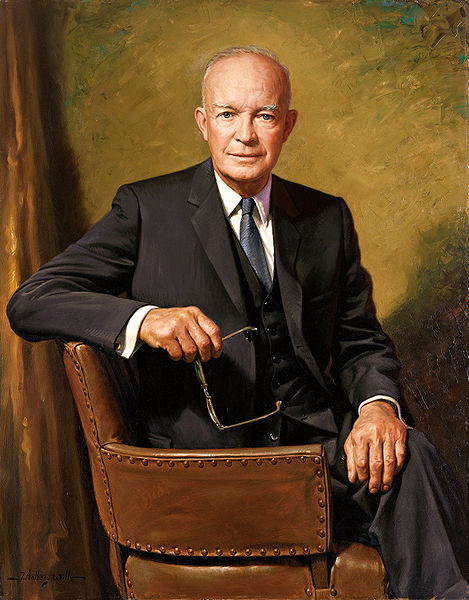
Eisenhower's official White House portrait

Sometime in the early 1950s Ike picked up a pocket knife from a dealer in Texas.  It was a Case Pattern 63 double ended pen knife.  Apparently Ike fell in love with the knife and ended up giving examples away as rewards and mementos.  He even had the blades engraved with his initials and date for special events like Presidential Dinners.  I won't dive too deeply into the relationship between Eisenhower and this knife since the knife author Gary Moore covered the topic in a great little article he wrote for Knife World Magazine in 2006 titled 'Ike's Knives'.  Follow the link and have a read.  It's a great story!

A week ago I was visiting my favorite knife store and I spied this little beauty.

Case Pattern 6263 'Eisenhower'

I'm not sure how much I like the lime green handle scales, but the history of the knife and Eisenhower's engraved signature on the blade meant it had to come home with me.

Apparently this pattern is very popular with Case collectors.  Case produces it in a number of styles, varying the handle materials and releasing them with and without the engraved signature.  Seems collectors can't get enough of 'em, and Case makes small variations from year-to-year to keep the addiction going.

Historical connection aside, this is just a great little knife and makes a great gentleman's pocket knife.  It is small and carries easily and inconspicuously in the trouser pocket and the rounded bolsters means it won't wear through the pocket.  The main blade is just long enough to be useful - cutting string, pulling staples, slicing an apple, carving up a steak (one of Eisenhower's favorite activities) or whittling on a pencil end.  Just a great little knife.  No wonder Ike loved 'em.

So that's it.  I like Ike and his favorite knife!

Stay sharp!

Brian

Saturday, October 22, 2011

So A Man Walks Into A Pharmacy...


And finds a knife store!

Back in June I attended the 2011 Blade Show here in Atlanta.  The W.R. Case & Sons knife company was set up showing off their wares.  If you've never seen a W.R. Case factory display it is amazing.  It's like they set up your rich uncle's study on the showroom floor, with deep carpeting and oak display cases holding hundreds of beautifully finished folding knives.  It's a jewelry store for real men.  I often say that Case knives "sparkle like Christmas", and the Case factory displays are specifically designed to highlight the high polish and unique handle materials Case uses on their knives.

Anyway, as I was looking at the knives in the display cases and leaving nose prints all over the place I asked the factory rep if they were doing any sales at the show.  Most of the other factory booths were selling knives to the show attendees and I'd already filled my backpack with new and exotic blades.  The Case factory rep told me that Case was not doing sales because they did not want to undercut any of their dealers who may also have a booth or table at the show.  His comment made sense; Case is highly reliant on their authorized factory dealers and wants to protect them as much as possible.  Many of these dealers are small mom & pop hardware or sporting goods stores that have been selling Case knives for decades.  Case promotes the idea of the Case knife as a uniquely American product that is still available in small town stores - it fosters the idea of small town America that is part of the perception they build around their products.

During our conversation the factory rep mentioned that one of the biggest Case dealers in the southeast was located just a few miles from where the Blade Show was taking place.  I pressed him for more details, and while he couldn't remember the name of the store, he did drop an intriguing bit of information - this dealer was also a pharmacist and he's got his knife store set up in his pharmacy.  I knew that CVS or Walgreens wouldn't be letting any of their pharmacists sell knives out of their stores, so this place had to be an independent operation.  Some internet sleuthing quickly turned up what I was looking for.

Tracy's Medicine Center
Tucker, Georgia

Hmmm... apparently Mr. Tracy isn't shy about the fact that he's both a pharmacist and a knife dealer.  See Mom, knives and drugs do go together!  And Tracy isn't just a nickle and dime knife peddler, he's a Case Master Dealer.  That means he sells LOTS of Case knives.

I just had to see this place in person so a few weeks after the Blade Show I headed up to Tucker (about an hour from where we live).  Tracy's was easy to find - it about the only business with English language signage left in the neighborhood.  An outpost of Americana in a sea of 'se habla Espaniol'.  I imagine Mr. Tracy feels a wee bit isolated.

I walked into the store and rounded the aisle holding cold remedies and was greeted with this sight:


Oh, there's more!


And yet more...


I love mashup of 'Home Health Care' and knives.  It works for me!

And a bit more...


By my estimation almost one third of the pharmacy is given over to knife sales.

When I entered the store I noted a guy about my age with a brushcut poking through the displays.  He commented that if I wanted to look at anything he'd be happy to help me.  This was Brett Tracy, the pharmacist and owner.  I took him up on his offer, and he proceeded to take me on a slow and careful guided tour though the display cases, not trying to make a sale but to demonstrate the variety, uniqueness and beauty of the knives Case produces.  It quickly became clear that Brett doesn't sell Case knives because they turn a good profit.  He sells them because he's a Case fanatic and he's found a way to subsidize his own addiction.

Yes of course I bought a knife from him.  Or two.  Or three.  I won't admit publicly.  And I've been back at least once and I'll be back again soon to do some Christmas shopping (a great excuse, eh?).

If you are in the Atlanta area and have an interest in Case knives I encourage you to drop by Tracy's.  You won't be disappointed!  They are located at 3171 Tucker Norcross Road in Tucker, GA.

Stay sharp!

Brian

Friday, October 7, 2011

An Interesting Provenance

I recently picked up a Becker BK-10 Crewman Utility knife.  Ethan Becker of Becker Knife and Tool (BKT) designed this knife years ago as a potential replacement for the Air Force Survival Knife.  Ethan essentially cut down his successful BK-9 Combat Bowie to create a shorter, lighter, tough and well balanced utility knife for use by military aircrews.

Becker BK-10

This knife was recently manufactured by Ka-Bar and is still offered for sale by them, but you won't see it listed in any Ka-Bar catalog or on their website.  In fact, Ka-Bar has never officially manufactured the BK-10.  Huh?

BK-10 marked Ka-Bar

So how can a knife not be made by a company that manufactures it and sells it?  That's the story that makes this knife interesting.

Let's go back to 2007.  At the time Becker Knife and Tool had a licensing arrangement with the Camillus knife company to manufacture the complete line of Becker knives.  This agreement included the BK-10.  However, in 2007 Camillus went bankrupt and all knife production ceased.  Ethan Becker then turned to Ka-Bar to take over production of the BKT line.  Ka-Bar jumped at the opportunity and cranked up production.  Ka-Bar is now the sole manufacturer of Becker knives and makes most of the same knives that had been produced by Camillus.  As part of the new licensing agreement Ka-Bar got ownership of all unfinished BKT knives and components that had been left in the Camillus factory.  Part of that haul was around 200 heat treated blade blanks for the BK-10.  

These blanks sat around the Ka-Bar factory for a few years while Ethan and Ka-Bar management tried to figure out what to do with them.  There were too few to open a new product line with, and besides they were Camillus blades.  Ka-Bar had not (and still has not) agreed to bring the BK-10 back into production, so these were effectively orphaned knife blades. 

Word of these orphaned blades leaked out to the Becker knife collector community (affectionately known as 'Beckerheads').  Discussions started up between the president of Ka-Bar, Ethan Becker and leading members of the Beckerhead community.  In a short time a brilliant idea was hatched.  Ka-Bar would finish out the 200 or so BK-10 blades as completed knives and sell them directly to the Beckerhead community as a special offering.  Ka-Bar was even able to secure enough original Camillus sheaths to include in the package.  

The BK-10 would effectively be a Camillus knife finished by Ka-Bar.  Sort of a Frankenstein move - raising the dead.

"It's alive!"

The knives were first offered to official members of the Beckerhead community.  You needed to have a Beckerhead membership number to be able to order a knife.  Once that demand was satisfied Ka-Bar opened sales up to the general public, but you had to call the factory to order one.  That's how I got mine.

An interesting knife with an interesting provenance.

So how good a knife is it?  Very good.  We'll get more into depth on that topic a little later.  But for today it's just about the provenance.

Stay sharp!

Brian

Thursday, October 6, 2011

Skeletor!

"I command you to bring me skeleton knives!"

It's almost Halloween, so let's have some seasonably appropriate fun!

Knives without handle scales - what are commonly called skeleton knives - are an interesting niche in the knife world.

Seems every knife maker feels compelled to have at least one, and often several, skeleton knives in their lineup.  The outdoorsy survivalist hunter-gatherer crowd has 'discovered' skeleton knives and has taken to them in a big way.  To hear them talk you'd swear nobody ever thought to make a thin, lightweight knife out of a single piece of steel until they came up with the idea.  Well, I've been around long enough to know that everything old is new again.

Over 30 years ago my Dad has a nice little Browning skeleton knife, a drop point skinner, that he carried now and again while fishing.  (Hey Dad, what ever happened to that knife?)

About 20 years ago I was carrying a nice little skeleton knife made by Gerber.  It had a wicked serrated edge and was designed specifically for white water rafters and kayakers.  It was intended to be used to cut free of any entangling rope or webbing and was carried in a neat little plastic sheath designed to be snapped onto a flotation vest.  I carried it while serving as a jumpmaster in the Army, strapped either to my load bearing rig or to my rucksack.  Its only purpose was to cut parachute static lines in case I had a towed jumper.  I thank God I never had to use it, but I have no doubt it would have done the job.

And that's just it; a successful skeleton knife tends to be a small, purpose built object.  The format, an all steel knife with no handle materials, introduces some interesting design challenges and restrictions.  The very minimalist nature of the skeleton knife means it's hard to get right and easy to get wrong.

Thankfully we've got a number of knife manufacturers putting out some really nice skeleton knives these days and for the most part they are getting it right.  Let's have a quick look at some.

Buck Knives leads off today first because I like 'em and second because they've got a really good lineup of skeleton handled knives, perhaps the largest in the industry right now.

Buck 140 Packlite Skinner and 136 Caper
The Buck 140 small Packlite Skinner and the 136 Caper are the two best models in Buck's lineup of skeleton handled knives.  They shine because of great handle shapes that make them comfortable to use and overall excellent balance.  The 136 Caper, in particular, is a delight in the hand and makes a great general purpose small knife.  I think a half dozen of these would make a really unique steak knife set.

Next up is the big brother to the 140, the 141 Packlite Skinner.

Buck 141 Packlite Skinner
The 141 is simply an upsized 140.  It too feels good in the hand, but the handle is getting a little large-ish to be considered truly comfortable.  Still, it is a very good mid-sized blade.

Next up is the Buck 143.  As far as I can tell this knife is only sold in Wal-Mart stores since that's the only place I've ever seen it for sale.  The 143 is the classic example of how small changes can have huge impacts on how a knife can feel in the hand.

Buck 143 Pakliite Skinner

The 143 sports a larger blade that is roughly the same size as the 141.

Buck 141 (top) and 143 (below)

But the handle is the same size as that found on the 140.

Buck 140 superimposed on the 143

Now, the combination sounds good, and to the marketing guys at Buck and Wal-Mart it must have seemed a winner.  In reality, however, it feels terrible in the hand.  The elegance of the comfortable handle from the 140 is ruined by the awkward transition to the larger blade.  The thumb ramp gets in the way and the whole knife feels awkward.  To make matters worse Buck has done no corner rounding of the metal handle and it is just uncomfortable to hold.  This is a Frankenstein's Monster that just doesn't work.

The sheaths that come with the Buck line of skeleton knives are nothing fancy, but they hold the blades safely and securely.

Buck 140 with sheath

The street price for any of these knives does not exceed $20.  In fact the Buck 141 goes for about $19.20 on Amazon.com right now, and it is the most expensive of the bunch.  The Models 136, 140 and 141 are great knives and well worth a look.  Take a pass on the 143.

Let's move on to my other favorite brand of knives, Becker Knife and Tool (BKT) made by Ka-Bar.  Becker Knife and Tool is really a one-man show, Mr. Ethan Becker.  Ethan is one of those guys who does it all.  He's a professional chef, writer, outdoorsman, and has been designing knives for over 30 years.  Currently Ka-Bar manufactures his designs and they do a great job.  BKT has three skeleton knife designs in its lineup, the BK-11, 13 & 14.

From top to bottom, the BK-14, BK-11 and BK-13

The BK-11 and 14 both share the same blade design - they are identical and they use the same sheath.  The BK-11 (in the center in the above photo) is wholly Ethan's design.  Ethan likes to eat and drink, and he wanted a small, handy knife that incorporates a bottle opener.  The BK-14 came about just a few years ago when a member on the BKT group on BladeForums.com decided he was going to marry the blade of a BK-11 with the handle of another extremely popular skeleton knife, the ESEE Izula.


ESEE Izula

The guy was a professional welder and did a great job, and the knife generated a lot of interest.  So much so that Ethan and Ka-Bar approached ESEE about copying their handle design.  The result was the BK-14, which is stamped with both Becker Knife & Tool/Ka-Bar and the ESEE logos.

(This BKT - ESEE mashup reflects the common relationships that exist in the American knife industry these days.  Knife manufacturing is a tight knit industry and there is a lot of cross-fertilization of concepts and designs between knife designers like Ethan Becker, custom knife makers and large volume manufacturers. The end result of all of this is that the American knife buyer has access to great knife designs for very little money.  This is truly the Golden Age of knife manufacturing in the US.)

Regardless of the handle design, the BK-11 and 14 are both great knives.

BK-14 with sheath

And what about that teeny little guy in the bottom of the photo, the BK-13?  Seems the BK-13 was designed as a knife that could be easily carried in an accessory pouch on the sheath of a larger fixed blade knife.  In fact, the sheaths for Becker's BK-7 and BK-9 knives include an accessory sheath designed specifically to take the BK-13.  By itself it's a good little blade.

BK-13 with sheath

That's about it for now.  Have I reviewed every skeleton knife available?  No, not by a long shot.  I've only reviewed those knives that have caught my fancy.  As more cross my path and catch my interest (and wallet) we'll take a look at them down the line.  

Stay sharp!

Brian