Awww geeze, not another blog!


Welcome to A Fine Blade!

This blog will focus one of my lifelong passions and one of man's most basic tools - the knife!

As time and events permit we'll tiptoe into other territory where we can use the knife as a metaphor in discussions about current events and have a little politically incorrect fun.

Because you see, knives rank just below guns as the most politically incorrect subject on the web today.

Guns & Knives = Bad. Gay Marriage & Recreational Drug Use = Good

We'll see if we can't have some fun with that.

So stay tuned, and welcome aboard!

Saturday, August 15, 2026

I Need A New Knife

Well, I don't need a NEW new knife. I need a knife that can live semi-permanently on my belt as I'm out doing chores. I want to try keeping my pockets as empty as possible. so my long-time favorite blade, my Buck Vantage, will get left behind. Instead I'm looking for a light folding knife with a blade length longer than the Vantage. This new knife's job is simple cutting chores around the house, and while outdoors. My first thought was something that caught my eye on the Buck Custom Shop page - a nice 110 folder with G10 scales and nickel-silver bolsters. But before going that route, I decided to see what I already had in my collection. Maybe there's something I'm overlooking in one of my boxes of knives.

Sure enough, after rummaging around and evaluating candidates, I found a winner. A 2011 production Bucklite 426 - a Buck 110 but with an orange nylon handle. This is one of two 426's I picked up over a decade ago. I don't remember why, but I'm sure they were relatively cheap at the time, maybe less than $30 each. The other 426 has a black nylon handle. 

Captured on a recent fishing trip

I've got a number of  standard 110s in my collection, picked up here and there as they caught my eye, or were gifted to me. My oldest was purchased sometime in the early 80s, at the Fort Bragg PX. It's the least lovely one in my collection, showing years of hard use. But it is, hands down, the most sentimental. I carried it on my pistol belt across a 23 year career as a combat engineer, construction engineer and a topographer (map maker). It deserves to go back to Buck for a spa treatment.

My early-80's 110. Carried on my pistol belt for most of my 23 year Army career.
Heavily used, and abused

My 110 collection reflects a number of the slightly different 110 blade profiles that Buck has released down through the years. I'll be honest and say that most of the profiles from the 90's thru the 2000's were too aggressively upswept. This profile resulted in fragile blade tips, which explains why so many broken tip 110s get returned for warranty repair, or end up on eBay. This 426 has one of the better blade profiles - far less 'swoopy', resulting in what should be a sturdier tip.

Bucklites are built to a price point, and it shows on mine. The main blade grind is rough, but even. The edge grind. however, is uneven and downright sloppy. I doubt Buck's current QC would let something this bad out of the factory. It's going to take some time on the whetstone to even things up. But that's OK, it's worth the effort.

If you have any experience with the regular 110 model, when you pick up one of these 426's you are struck by just how light they are. There's a lot of weight in the standard 110 handle - all that brass, steel and faux wood handle material. The blade itself adds relatively little to the weight of the knife. My 426 has a very lightweight molded nylon handle. The knife balances very nicely around the first finger scallop in the handle. It's very comfortable in the hand.

This is not an heirloom knife, and with use it'll suffer the fate of all folding knives that get regular hard use - the pivot pin bushing will wear, the blade will loosen up in the handle and the knife will become unusable. Or the blade will break, or the handle will crack, or I'll lose it. I figure it's good for about 10 years of honest use. That's OK, because that'll give me time to hunt down another orange handled 426, or maybe Buck will re-introduce them. Hint, hint.

Stay sharp!

Wednesday, August 12, 2026

Spinning and Fly(ing)

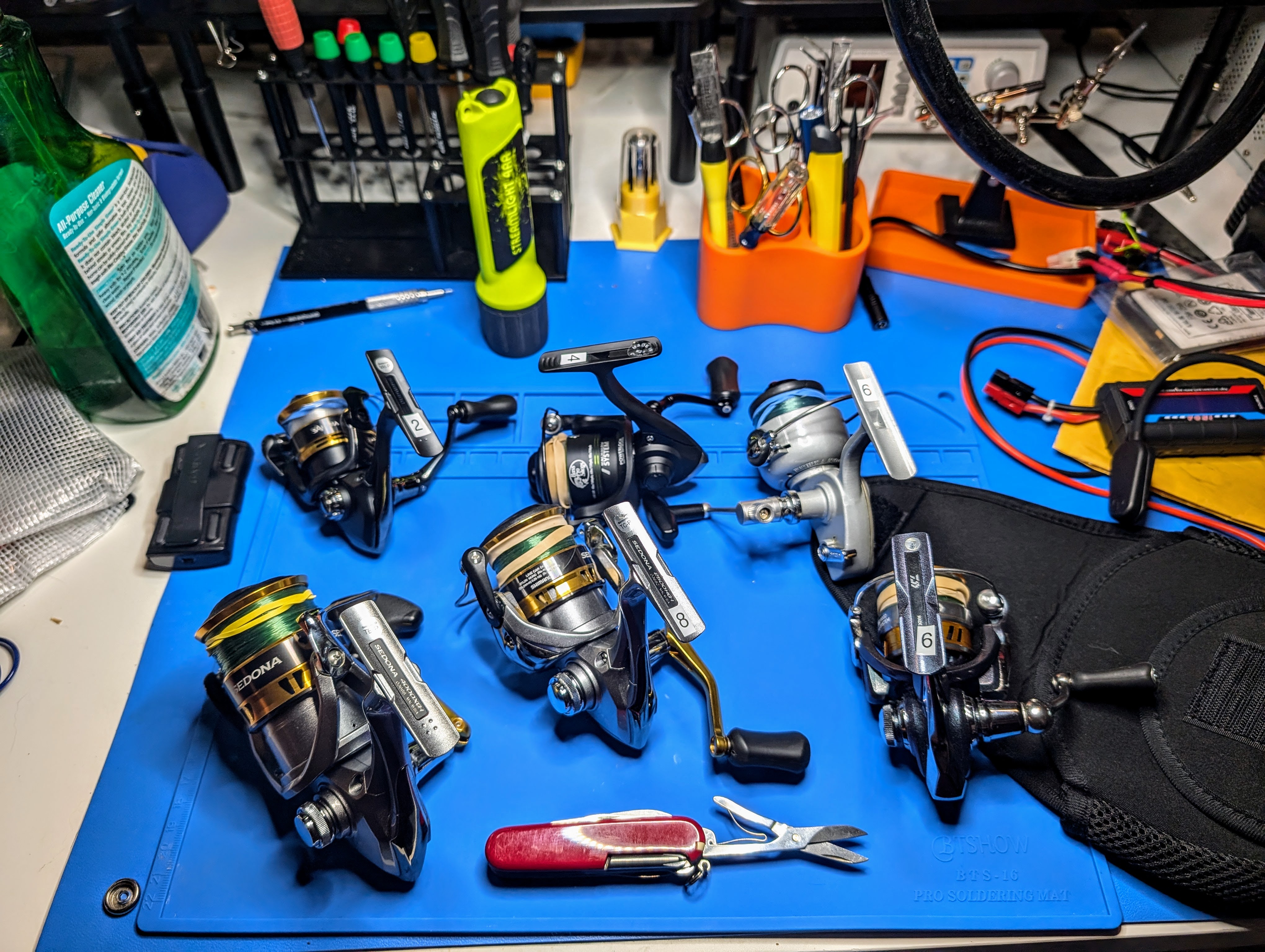
This past Sunday, for the first time in months, I was able to get away for a few hours and get some fishing in. Didn't catch a thing, but that wasn't really the point. I wanted to check out a new spot for future fishing adventures. I didn't care if I caught anything, I just wanted to check it out.

I went to one of Georgia's wildlife management areas (WMA) that's about 40 minutes from my house. Named the Joe Kurz WMA, it's mainly a hunting location, with managed fields and habitat for deer, turkey, doves and quail. It also offers a primitive camping area,  a small lake, and boat ramp access to the Flint River. 

I was particularly interested in the primitive camping area and lake. I didn't know what to expect, so I tossed some spinning gear into the back of the truck and took off. There were a few other folks fishing when I got there, but nobody was catching anything. I tossed out a beetle spin (my go-to lure for bluegill and small bass), and I saw some small bass following it, but nothing was biting. I put it down to the heat - it was pushing 90 degrees that day. As I walked the bank of the pond with my spinning gear I noted that it's also a good location for fly fishing. Clear banks, plenty of area for long back-casts. 

So this observation introduces our topic for today - don't be a tackle snob.

I've been fishing since I was about four or five, starting when I fell off the boat dock at our vacation cabin on Lime Lake, in western New York. I was pissed at the sunfish for stealing my bait (small pieces of bread), and was leaning over to yell at them when I slipped and fell in. I still think my older brother Pat pushed me, but he continues to deny itπŸ˜„. I can remember the fishing gear I had - an inexpensive little panfish outfit with an open face reel and a blue plastic rod handle. I loved it!

1960-ish. Lime Lake in western New York. My earlier spill from this dock triggered a mandatory life jacket policy 

Since that fateful day I've fished all across the US - from the ponds and small streams of South Jersey, to the lakes, rivers and ocean beaches of Georgia, Ohio, Michigan, New York, North Carolina, Virginia, Texas, Washington State and the Panama Canal Zone. Many of my favorite memories involve fishing.

Fishing the Maumee River in NW Ohio, renowned for its white bass and walleye runs.
Mid-1970s


Early 1980's. Somewhere on the North Carolina coast.
Me on the left. A good friend and Army buddy John Laughter is on the right. Can't remember the 
guy in the middle - another officer from our battalion on Fort Bragg.
We were cleaning fish until midnight

Life often gets in the way of things, and so it did with fishing. Raising kids, being sent hither and yon by Uncle Sam, other interests (some of which are discussed on this blog). I found myself wetting a line less and less. Then in 2007 I went to work at Hartsfield Airport in Atlanta, and developed a close friendship with one of the airport planners, a fellow retired Army officer, fellow New Jersey expat and dedicated fisherman named Bill. Bill absolutely loves fishing. Fly fishing, that is. I had only fly fished once or twice in my life, using borrowed gear, and didn't have much luck. Bill became not just a close friend, but my fly fishing coach and mentor. Under his tutelage, I got good at it. Not great, but good.

Bill, working the bank of a local stream. Thinking of trout, but willing to settle for a nice bass.

Along the way I discovered one of the unspoken secrets of fly fishing - it's OK to not give a damn about catching trout. Trout down here in the deep south are just dumb hatchery raised pellet-fed hogs. The real fun is taking a 2 or 3 weight fly rod and go looking for beds of aggressive bluegill, some crappie, or largemouth bass. In fact, I'll take a largemouth bass over a trout any day of the week. More fight, more fun. However, expressing that feeling at a Trout Unlimited meeting (which I did) is the equivalent of pissing in the punch bowl at your cousin's wedding. Kinda' kills the mood. Sorry (not really), but I find the pretentiousness of fly fishing, as practiced by the Orvis crowd, to be tiresome. Love the activity, hate the snobbery shown by a large number of the practitioners. And no, Bill is not one of those.

Me (on the left) and my son-in-law Shawn, getting ready to float fish on one of the stocked ponds
at Callaway Gardens in southwest Georgia. The trout were not cooperating, so I just puttered along the 
edges of the pond, tagging some really impressive bluegill.

Years ago Bill and I made a trip to fish the tailwater up on the Toccoa River in north Georgia. I was standing about five yards out, casting into the foam and not having any luck. I was also hearing an occasional splash behind me. I turned around to look, and was surprised to see trout rising to grab insects falling from a tree on the bank. One of the bugs floated by me, and it looked like a small spider. There must have been some sort of spider hatch going on in that tree, and the trout were having a field day. I spun around, grabbed my fly box, pulled out the smallest spider-y looking thing I had and tied it on. On the third cast... bam! On the fifth cast... bam! and so it went for about 15 minutes. As I'm standing there pulling in another trout a guide boat floats by. One of the dudes on board calls out, "How's it going?" I shout back, "Pretty good, four in the last 15 minutes!" Then comes the inevitable question, "What are you using?" I shout back that I've tied on a small foam spider. He shouts back, "You'll probably have better luck with a hopper and a dropper combo!" Really? He's giving me advice as I'm landing my fourth trout in 15 minutes... right in front of him? He and his buddy looked like they just stepped from the pages of the Orvis catalog. I'm standing there in waders from Cabela's, with a Bass Pro fly rod, some cheap fly line I picked up at Dick's, and a few crappy flies I tied up myself. I had a fish on, these guys didn't. But they looked snappy as they bobbed on by, smug in their knowledge that the rube in the river could do better if he just followed their advice.

Fly fishing dominated my fishing life for at least a decade. I love it. But there were certain situations where it was clear fly tackle was not the best solution. Windy days, times I knew I needed to get deep with the fly to get to where the fish were holding, heavy weeds, no space for back-casts, things like that. I didn't want to give up on the 'purity' of casting a fly. so I just didn't fish those situations. 

About eight years ago our young granddaughter Helen was staying with us for a few days. Roberta asked, "Why don't you take her fishing?" A great idea! Helen was excited at the prospect, too. But it struck me - I didn't have any tackle she could use. No way was this kid going to be able to use fly fishing gear. Off we go to Wal-Mart, and while I'm sure she really wanted the Disney character spincast outfit, I upgraded her to something a little better. We grabbed some split shot, small hooks, bobbers and a loaf of Wonder bread, and headed to the lake. The bluegill were hanging around the dock pilings, just waiting. I tied on a hook, added a split shot, snapped on a bobber, and baited the hook with a small piece of bread kneaded to a dough-like consistency. Helen was fascinated - bread for bait? She dropped her hook into the water and was watching the smaller bluegill peck at the bread when a large female charged out of the depths and grabbed the hook. This was Helen's first real fish, and it was stripping line off the reel faster than she could crank it back in. We got things under control and she landed a nice fat momma bluegill. She was excited, but concerned that we get momma back in the lake as soon as possible. We dropped the big 'gill back in the water and she hung near the surface for a few moments getting her bearings, then darted back to the deeper water. Helen watched it all and just kept saying "Wow, that's neat!" To this day she swears that Wonder Bread is the best bait ever for bluegill, in the whole wide world.


That got me thinking. Am I missing something by turning my nose up at spinning gear and other conventional tackle? Helen didn't care what she was using. She was just excited to catch a fish. Am I as snobbish as those dudes on the Toccoa River? I remembered something written by Lefty Kreh, the late dean of American fly fishing. It goes like this - don't be so snobbish about tackle that you miss good fishing opportunities. He recommended taking spinning tackle along on trips for precisely the reasons I list above - windy conditions, the need to get deep in the water column, heavy bank brush, etc. You go fishing to catch fish, not to show off your latest rod purchase from Orvis. 

It was about this time I lost my father. Dad was an avid fisherman who loved to fish along the Jersey shore, or along the banks of the Maumee River in Ohio, or out on Lake Erie from his sailboat. My siblings had no interest in his old tackle, so I inherited it all. I got it all back to Georgia and started to go through it. Dad was very type A, and kept everything 'just so'; When I opened up his collection of spinning reels I was surprised to find the insides spotlessly clean and freshly lubed with grease - ready for the next fishing adventure that never came.

Dad, on his sailboat on Lake Erie with one of his late 1960's vintage Penn Spinfisher reels.

It's as though Dad was telling me... get back out there and start fishing with whatever you've got.

I went into my garage and dug out my old ultralight spinning setup. Nothing fancy, just something I had purchased at the Fort Bragg PX oh-so many years ago. The combo had served me well when wet-wading the Little River in North Carolina, looking for largemouth bass and chain pickerel hiding in the snags and overhangs. Some new monofilament line and a package of beetle spins, and I was back out on a nearby lake, enticing a surprising number of crappie out of the deeper pools. I didn't intend to step away from fly fishing, I just needed to convince myself that spin fishing was still fun and productive. It was, and is.

About a year later Roberta and I were camping down at West Point Lake on the Georgia/Alabama line. Our spot offered easy access to the lake. One lazy afternoon, while Roberta was napping in the hammock, I grabbed my spinning gear, walked into the lake about knee deep and started tossing out a little Mepps spinner. Almost every other cast earned me a nice bluegill or small bass. It was an amazing experience. I was a kid again, standing on the bank of a small tannin-stained creek on the edge of the New Jersey Pine Barrens, tossing a spinner into the dark water and hoping to hook a bass or sunfish.

Since then, I've changed my outlook. I no longer try to make the fishing situation match my fishing gear; I make my fishing gear match the fishing situation. Today I take it all out with me. My gear load-out normally includes both fly fishing gear and spinning tackle, even for short trips to local lakes. 

As Lefty Kreh (and my Dad) said, don't be a tackle snob. The goal of fishing is to catch fish, right?

Not mighty, but mighty fun!

Stay sharp!


Thursday, July 9, 2026

Young Washington - A Movie Review

As Supergirl tanks badly at the summer 2026 box office, another film is quietly building an audience and has actually found some favor with 'professional' reviewers, like the egg-sucking leftist bunch over at rogerebert.com. How could a jingoistic neocon low budget flick tossed together by a studio known mostly for cheap holy roller shlock - Angel Studios - pull this off? Well they could, and they did. 

The movie is Young Washington. Let's get the 'holy roller' stuff off the table right up front. There's nary a trace of overt Christianity in this movie. Washington never goes down on bended knee asking for divine guidance, there are no preachers, no bibles, nobody invokes the Lord's name. Nothing. The only visible Christian symbol, other than crosses on a few church steeples, comes at the end of the movie when Washington is parlaying with a group of Indians. One of the chiefs is wearing a sash that carries what is clearly a Christian cross. Washington shows no interest in it, doesn't even notice it.


Yet Young Washington is clearly anchored in Christian values - devotion to family, morality, duty, honesty, service. So in that sense, it's a very Christian movie. It works because that's what Washington was - a very moral and honest man who understood his duty and responsibilities to his family, his soldiers and his nation. 

The movie also mercifully excludes any 'girl boss' bullshit. Women of the mid-18th century are accurately portrayed as to their roles in society and the challenges they faced. We're also not subjected to what I'll call the 'sharp negro' syndrome, where the wily slaves outwit and make fools of their masters and other white characters. Blacks are portrayed as precisely what they were in the mid-18th century - cheap and often expendable labor. Sorry if that offends, folks. That's history.

Young Washington is blessed (see, there's that religious thing again) with a great story to build on, great screenwriters, a great cast, and a first rate director, cinematographer, set designers and costuming crews. It's not a perfect movie - in my book it gets 4 out of 5 stars. There are some minor dialog issues, some overly long battle scenes that could have used tighter editing, and some obvious mistakes with weaponry. The surveying scenes are a joke. I used to be a surveyor, and have an strong interest in the history of surveying, so I know. But I can forgive all of these quibbles given the overall quality of the movie.

Let's discuss the stand-outs in the cast. George is played by British actor William Franklyn-Miller (what's with these pretentious hyphenated names among the acting set?). He does a great job as the main character and holds the movie together. I think he accurately captures the young Washington - inexperienced, ambitious, over-reaching, yet set with a strong moral core and a willingness to learn from his mistakes.

Mary-Louise Parker as Washington's struggling mother gives the strongest performance of the movie. She is absolutely superb in the role. Her angst, almost desperation, to keep a plantation running while raising two boys (George and his younger brother) highlights the struggles of many women shouldering enormous responsibilities within the confines of mid-18th century colonial America.

Ben Kingsley plays Robert Dinwiddie, the lieutenant governor of the colony of Virginia, and the man who gives Washington his start on a military career. Kingsley is incapable of giving a bad performance in any movie.  Although he sort of loafs through this one, he still turns in a great performance as an upper-crust British aristocrat who at first looks down on Washington as an inexperienced colonial bumpkin with a lot of pretentions (which he was), but gradually sees the potential in this young man as a leader and someone who can make a quick study of a situation and adjust as necessary. 

Mia Rogers plays the young Sally Fairfax, Washington's first love. Rogers plays her role expertly - someone drawn to the brash young Washington, yet always understanding that she's little more than a prize, or a pawn, in the colonial Virginia high society/high stakes marriage game. She loves Washington but understands he can never compete with the more eligible suitors vying for her hand. In real life, Washington apparently never got over her. As Mia Rogers plays her, I can understand why.

John Foss plays George's older half-brother, Lawrence Washington. This role is key to understanding Washington and what he became. After their father's death, the British educated Lawrence took George under his wing and became his teacher, mentor and surrogate father. It's fair to say that without Lawrence's guidance, George Washington would be just another footnote in a tidewater Virginia family history, and we'd very likely have remained part of the British empire.

There is rumor that, based on the success of Young Washington, Angel Studios is considering making this movie the first of a three part series. I hope they do, because there is so much more of George Washington's story left to tell. Of course we a know (or should know) about his struggles at Valley Forge, the crossing of the Delaware River and the Battle of Trenton, and the final siege at Yorktown. Those are the stories that gave us George Washington the iconic hero. But the 20 years between the 1755 Battle of the Monongahela, where Washington finally finds his footing as a field commander, and 1775, when Congress appoints him as the Commander in Chief of the Continental Army, is the period that made George Washington the man. 

Stay sharp!

Sunday, May 31, 2026

I Think I'll Do A Movie Review

I've seen a lot of crappy movies in the past 6 months, both in theaters and on-line. Some, like The Mandalorian, I knew would be crap because the streaming series is crap, and the movie is just a couple of the TV episodes stitched together. But my wife likes the series (mainly for baby Yoda) so I went. I wasn't disappointed - it was crap. Then there's Nuremburg, with Russel Crowe and Rami Malek. In every scene they had together, Crowe mopped the floor with Malek. It wasn't so much that Crowe was the better actor (he was), but that the story the writers delivered had so much made-up psycho-babble drivel that Malek didn't have much to work with. The same could be said for every other character in the movie that wasn't Hermann Goering. All the other movies were so 'blah' that it's hard to just remember them.

I had been following the talk about the movie Pressure for several months. I'm very familiar with the movie's subject - the struggle to deliver an accurate D-Day weather forecast to General Eisenhower and his commanders. The story of the development of this forecast, and the decisions Eisenhower made based on these forecasts, is one of the fascinating pieces of the history of D-Day. It's also a story that's been well understood by historians for over 80 years. So nobody wanting to tell the story on film has to guess or make anything up. It's all there in the history books, and it's a fascinating tale with a number of intersecting scientific and military components. More than enough history material to fill a movie screen for two hours.


The story of the D-Day weather forecasts also has a huge built in audience. Every weather geek and every WWII history buff  - a combined audience of millions - would stand in line to see a well crafted story. And this is just in the US. A well done movie would play well in theaters in the UK, France, Belgium, and the Netherlands. This story is, after all, part of the story of their liberation from the Nazis. This is also a story where everyone gets to be a hero. There are no bad guys in this tale, just struggles to understand what the data is presenting, and then trying to fit the invasion around the only factor the Allies can't control - the weather.

So the writers and the director (who was part of the writing team) had a great story with plenty of historical resources. Those resources were not just facts and figures; there's also a lot of well done study on how Eisenhower and his senior commanders made the almost hour-by-hour decisions based on the developing weather picture. The decision processes they went through are fascinating, and are still studied today. But it's as though the movie production team didn't want to be bothered reading the material and building the story from it. Instead they got lazy and set up a fictitious personality conflict between the leading meteorologist, Group Captain Stagg, and an American meteorologist, Lieutenant Colonel Krick. By focusing on this conflict, the director almost completely misses the historical context and importance of the contributions these meteorologist made to the success of D-Day.

My problems with this movie go beyond just a crappy story crappily told. Let's start with the cast. With just one exception the primary cast is excellent. Let's get the really good ones out of the way. Damian Lewis, who played Major Dick Winters in the series Band of Brothers, plays Field Marshall Montgomery. Lewis understood his character better than any other cast member, and plays Montgomery to a 'T'. His is the standout performance in the movie. Kerry Condon plays Kay Summersby, Eisenhower's personal driver, secretary, confidant and, OK, alleged lover. While Condon's role in the movie is fictitious, she plays it wonderfully, as the steadying influence standing between Eisenhower and Stagg. Yes, she's a made-up plot device, but it works.

But now we have to talk about Brendan Fraser. I like the guy, I really do. He's a talented actor (and has an Oscar to show for it), but  Eisenhower just wasn't his role. To start, Fraser is still struggling with his weight. He looks bloated. Eisenhower was trim, with an athletic build. Next, Fraser just didn't seem to understand his character. Eisenhower, even when under enormous pressure (like the lead-up to D-Day) was calm and collected. He didn't yell at subordinates. He knew he needed to project an air of confidence and strong leadership to his staff and the thousands of American and British soldiers under his command. He had history altering decisions to make, and he knew that shouting and berating his staff was counter-productive. Unfortunately Fraser spends a lot of time shouting. Perhaps the worst interpretation of Eisenhower was the scene where Fraser re-creates Ike's D-Day 'Great Crusade' address to the troops. Eisenhower recorded it ahead of time for later broadcast, but most soldiers and sailors received it as a printed message handed to them on the evening of the invasion. Broadcasting the address to the ships would have alerted the Germans that the invasion was imminent. Yet the movie has Fraser, as Eisenhower, shouting into a microphone as the address is broadcast live to the invasion fleet just off the coast. Didn't happen. Perhaps it's unfair to blame Fraser for this - maybe he was just playing the scene as the director told him to. But Ike's recorded address was delivered in his deliberate, clipped, midwestern voice. Fraser would have done well to follow that example, rather than yelling in his naturally shrill voice. I guess the production team just had to put their own spin on the event, and the result is awful. About the only thing Fraser got right was Eisenhower's smoking. Ike was a chain smoker, and the habit eventually led to his death. A lot of actors today have difficulty faking the smoking habit - the 'affectation' of smoking. There are certain ways long-time smokers hold cigarettes, use lighters, etc. Fraser had this down pat, and he has Eisenhower smoking in almost every scene, which would have been accurate. Makes me wonder if Fraser is a smoker in real life.

Next up, uniforms. Jezus H. Christ, could these people not hire a competent costuming team that understood WWII uniforms and how they were worn? The errors were everywhere, and to an old soldier like me who spend over two decades in uniform, they were galling. Soldiers don't go around with loose neckties. They don't go to formal briefings or meetings wearing only partial uniforms and rolled up sleeves. They don't wander around with their uniform shirts unbuttoned almost to the waist. And female soldiers don't wear earrings, particularly pendant earrings (which the Kay Summersby character is always seen with). The individual uniform items may have been correct - the shoes were the right color, the patches were sewn on correctly, etc.- but how the actors wore them was awful, and would have resulted in lots of ass-chewings in the real world. 

So we have a bad script, bad direction, and a bad historical portrayal. Why, I mean, WHY?! It could have been so easy to put together a crisp and fascinating story based on the well-understood challenges. There were challenges in the science and art of weather forecasting, challenges in balancing weather against operational requirements, challenges in making sure the Germans were denied the ability to develop their own accurate weather picture. Nobody has tried to put this on film before, so it's not like the writers and director needed to find their own 'spin' to separate this movie from all the other D-Day weather flicks. 

It really comes down to nothing more than poor story development, poor writing, and poor directing. I don't think Pressure will age well in comparison to all the excellent WWII films and series that have been released in the last 30 years. It all started with Saving Private Ryan, which established a new war movie production paradigm that demands good story and production accuracy. These movies portray real people that changed history. To do a sloppy job on even the small stories is an insult to their memory.

Stay sharp!

Monday, December 15, 2025

A First (For Me)

Several days ago I met my friend Bill, and one of his old National Guard buddies, at a local shooting range. The friend brought along a number of guns, one of which was this very nice M1 Carbine with a Saginaw Gear marked receiver.

I've owned a lot of guns in my time, and I've shot more than I've owned, but I have never shot an M1 Carbine. Well, after 69 years this range trip fixed that shortcoming. Bill's friend allowed me to put a magazine through the little rifle, and I was enchanted. Great handling, excellent sights, very nice trigger, and acceptably accurate (about 4 MOA as I shot it).

Sadly, given my age and stage I doubt there'll be an M1 Carbine in my collection, unless someone just gifts me one, but having shot this one I now understand why they remain incredibly popular.


Stay sharp!

December 2025 Update

Here I am again, making excuses. It's late December, 2025, about a week away from Christmas, and it's occurred to me that this blog needs some serious attention. Not new posts, per-se (although there's going to be more of those coming in the new year), but in cleaning up stuff I've posted in the past. This comes down mainly to fixing broken links, replacing photos that no longer load properly, and doing some minor grammar updates on posts I think are important.

You see, I will finally retire in early January 2026. My kids tell me I've threatened to retire too many times for them to take me seriously this go-around. So to prove how serious I am about hanging things up, I've gone ahead and filed for Social Security, and I've even formally notified my employer that I will, in fact, retire on January 9th. Even they didn't take me seriously, at first.

This blog has been put aside for several years as I followed other interests. However, I've decided that, since I no longer need to play nice and bite my digital tongue on issues like firearms, politics, morality and other fun stuff, I'll re-energize this blog as a more 'pithy' outlet for my thoughts. 

So stay tuned for more. More knives, more guns, more shooting, more fishing. More of everything you love... well, OK, more of what I love!

Stay sharp

Sunday, August 10, 2025

Hand Tool Renewal Two

Several weeks ago, on my other Blog - PRC-77.com - I put up a post about how I'm cleaning out several decades worth of old hand tools, and re-setting for my new interests. I wrote this follow up, but then decided to move the tool discussion over here to A Fine Blade because it's a better subject fit, and I need to re-invigorate this blog.

When I published my Hand Tool Renewal post, I thought it was a one-and-done; I didn't think there's be anything else to discuss. But the last few weeks on this tool renewal thing have been very interesting, and even this old dog learned some new tricks. Thought I'd share.

Mechanical systems have always fascinated me. I've been turning wrenches on things like cars, boats, motorcycles, bicycles, fishing tackle and firearms for over half a century. My fascination is a bit odd because while my Dad was an incorrigible tinkerer, he was mostly into wood working and small home repair, and keeping his sailboat up to snuff. I honestly don't ever remember him looking under the hood of a car except to curse at the blasted beast for not working the way he thought it should. Dad loved cars, and loved driving them, but as far as I can tell never had any special interest in working on them. He left that to 'the guy' who ran a gas station and service shop just up the street from us. And on occasion, me. On the flip side, I have very little interest in wood working. I can saw, hammer and drill with the best of them, but taking on anything larger than home maintenance projects just doesn't interest me.

Early in my driving career I inherited a well used '68 VW Beetle. I drove that thing through almost four years of college, commuting back and forth every day, and driving it to the various jobs I had in the Toledo area. Dad wasn't going to put a single dime into it, so it was up to me to keep it running. Having to keep a car running in order to make it to school, and to various jobs to be able to afford school, resulted in one hell of a compressed education in automotive maintenance. With the help of the classic 'How To Keep Your Volkswagen Alive' manual by John Muir, and a Haynes manual for the VW Type 1 I became a fair-to-middling home mechanic. John Muir's manual is an absolute classic, done in a funky 1960's 'hippie style', but was a remarkably complete, expertly written and humorously but precisely illustrated. This book is a classic, still in publication and still sells well, even though most of the millions of VWs it was intended to help keep on the road have long since gone to the crusher.

The original manual, published in 1969, had only black & white illustrations
and covered drive trains from the early 50's right up to 1969. It became THE
bible on VW maintenance & repair for the owner/tinkerer

There were some maintenance problems beyond my skills, and for those I took the car to 'a guy' named Alan on the north end of Toledo, who did a garage-level business in VW repairs. I ended up working for him for a few months one summer in the mid-70s just to get some experience. He had me doing mostly brake jobs and carburetor rebuilds, but I learned a whole lot from him just by watching and asking questions. One of the things I took note of was his collection of tools. This guy had retired out of a commercial automotive maintenance shop in Toledo and a lot of his tools were old brands that I can't even remember. One thing I do remember is that he had a lot of Craftsman wrenches laying around. I asked him one day if Craftsman were the best, and Al's response was interesting. He said they were good, and he liked the warranty, but the main reason he bought Craftsman was because Sears was just up the road, and was one of the few places you could go that offered a comprehensive line of metric tools. It was easier to go to Sears to buy a Craftsman wrench than drive across town to a specialty tool shop.

I took Al's comments to heart and began buying mostly Craftsman metric tools. Although often tempted by the sexier offerings from the tool truck guys like Snap-On and Mac, they were far beyond my means, and Craftsman offered the quality, range and availability I came to count on.

Fast forward half a century (oh God, am I that old!?) and while my tool focus has shifted, my appreciation for (and ability to afford) very good tools is unabated. In my last post I covered what was a refresh and expansion of tools to support my electronics bench work. That upgrade is about complete. Now I'm going after the larger tools I use for home maintenance, light automotive maintenance, and maintenance on our camper. In my car port storage room I've got a roll-off tool chest that is packed full of a mish-mash of old stuff - hammers, tap & die sets, wheel pullers, specialty tools, pry bars, hatchets, sharpening stones, at least two, and sometimes three, semi-complete socket sets for both metric and SAE bolts, some old Craftsman screwdrivers with the clear acetate handles that have developed the classic 'funk' coating (that phenomenon is an interesting story in itself, but suffice to say there's no real cure) and other odds and ends.

Then there's electric tools. I'm switching completely from corded tools to cordless. I donated the last of my corded tools to our church rummage sale a few months ago. For several years I've been buying into the Ryobi line of battery powered equipment, both for their power tools like drills and saws, but also for the wide variety of accessory items they make, such as portable fans, sprayers and lights. While Ryobi makes good DIY-grade gear (and it really is well designed and manufactured stuff), what they make often doesn't provide the necessary 'oomph' that pro-grade power tools offer. This came to light when we burned out a Ryobi drill when using it to lower and raise the stabilizers on our camper. Right now I'm teetering between two replacement brands for heavier duty power gear - Milwaukee and Harbor Freight. I know many of you are stroking out at the mention of 'Harbor Freight', but their Hercules line of cordless tools gets excellent reviews, even occasionally beating the comparable Milwaukee tool (example, a 1/2" cordless drill) but at about half the price. I don't want to support three battery systems (Ryobi, Milwaukee and Harbor Freight), so I'm taking a hard look at the Milwaukee and Harbor Freight offerings to make a decision.

So what do I need to keep in that old roll-off in my storage room? Since my heavy automotive wrenching days are over, remarkably little. A set of screw drivers, a 3/8" & 1/2" metric socket sets that take me from 10mm to 23mm, a few specialty wrenches for things like tightening ball hitch nuts, an adjustable wrench or two, some slip joint pliers, linesman pliers and... that's about it. Now, this roll-off cabinet isn't the only place I keep tools. I have a 5 gallon bucket inside my house with common use home repair tools and I also keep a set of tools in my truck - cheaper Harbor Freight versions of socket sets, wrenches, pliers, etc. Considering it all, I guess I'm 'well tooled'. 

This has left me with a lot of spare tools. The broken, rusted or unserviceable stuff  (like the screwdrivers with the funky handles) got tossed. The serviceable excess got put into 5 gallon buckets. Drop in a Z-Rust tab, snap on a lid and put the buckets in the corner of my storage room for any future need. If in a few years I find I don't need to dip into this spares stash, it will all get donated to a worthy cause.

Shopping for new tools has become an interesting lesson in global manufacturing shifts in the Era of Trump. Before Trump and the tariffs, communist China was the leading hand tool producer, and to be fair, they made some pretty good stuff. I've already discussed this in regards to knife manufacturing. Taiwan and India were the other two hand tool production centers. Taiwan has a long history of making high quality tools (and knives) but their production costs were always a bit higher than communist China or India. Long ago I made the personal decision to not buy anything from China; they are at war with us, and every purchase fuels their efforts to undermine us. But the tariffs, even just the threat of tariffs, have forced US tool retailers to shift production to other locales. We are now seeing an increase in production coming out of Taiwan and India, and Vietnamese made tools are becoming increasingly common. The tools made in India area still somewhat crude. I recently looked at a set of Craftsman combination wrenches made in India, and they were rough - poor stampings, lots of metal flash, poorly broached box end sections, etc. A corresponding set of Taiwan-produced wrenches, just one display over, were very nicely forged, finished and chromed. Yes, they were twice the price of the India-produced set, but still well worth the cost. I don't have a lot of experience with Vietnamese produced hand tools, but the few I've looked at (brands included Husky, Milwaukee and Channellock) seem well finished. While Vietnam is still a communist country, at least they cooperate with the  US, and are not trying to undermine us. So, I'll keep an eye on Vietnamese tools.

That's it, for now. My next focus needs to be measuring tools, to include things like calipers and tapes. But, I'll leave that discussion for another day. For now...

Stay sharp!

Wednesday, November 13, 2024

Trangia

When I'm not writing about knives, guns, fishing, stupid politicians (almost a full-time job there), radio and other stuff, I can be found playing with camp stoves. Yes Virginia, collecting and 'fettling' with camp stoves is a thing, and grown men do it. I mean, why not? It mashes up two of the human male's favorite things - fire and food. Add a bottle of beer and you have the trifecta. I've been 'into' camp stoves since I was a Boy Scout, and that interest was fueled  (ha, ha) by books like Colin Fletcher's classic 'The Complete Walker'. I'm interested in anything that puts out a flame - from classic old Coleman two burner suitcase stoves to the modern ultra-light backpacking stoves manufactured by companies like MSR. 

I've written in this blog a few times about various stoves like the old Swedish self pressurizing brass stoves and single burner military stoves. I took a pause on this interest for a time, but a few years back, while camping with my wife, my interest was renewed. She was taking a nap one afternoon and I was puttering around the campground, and the thought struck me, "This would be a great time to play around with some old stoves". And just that quick, I was back into fettling with stoves ('fettling' is a quaint British term for tinkering around with something to fix it or make it better - a wonderful word that perfectly describes playing around with old camp stoves). 

Several months ago I made a huge mistake - I went down a discussion rabbit hole on the Classic Camp Stoves website (a very dangerous site for those who like to fettle) and learned about something I don't think I'd heard about before - cook sets made by a Swedish company called Trangia. I may have heard about them but never paid much attention because the stove part of the Trangia cook set is a simple (but ingenious) unpressurized alcohol burner. With the Triangia system you don't get a pressurized roaring flame, you get a silent, pokey, alcohol flame. I'd dealt with other alcohol stoves in the past - little more than a cup filled with denatured alcohol and a small pot stand. The performance wasn't impressive. But what Trangia did was interesting. They combined an improved and more efficient alcohol burner with a burner support and wind screen that improves the overall performance of the burner, making it a viable way to heat water and cook small meals. Now, Trangia didn't come up with this in 1980, or even 1960. The Trangia 'storm cooker' set was designed in 1951! This isn't a backpacking stove (although I'm sure more than a few were carried on backpacking trips). It's really more of a car camping or picknick cooking setup. 

The basic storm cooker sets consist of a burner stand and windscreen, two nesting pots, a fry pan and a pot grabber. Every set also includes Triangia's signature brass alcohol burner. Some sets also include a small tea kettle. Everything is made out of stamped aluminum, and Trangia offers sets in bare aluminum, a non-stick coating (like Teflon, but not Teflon), hard anodized aluminum or a unique material called duossal, which stands for 'dual stainless steel and aluminum'. This is basically an aluminum and stainless steel pot bonded together under immense pressure, so the cooking surface is stainless steel, but you get the better heat dissipation of aluminum on the outer shell. 
The plain aluminum cookset. Simple & well thought out

These sets can best be described as 'old world' and 'charming'. They harken back to an era when lunches were put into wicker baskets and loaded into the boot of the old Morris for a day of sightseeing along the ancient country roads of Yorkshire, stopping to eat lunch and brew up some tea and soup in the shelter of an old stone farmhouse while watching the sheepdogs move their charges from one field to the next, and wrapping yourself in a wool shawl as the cold mist settles in for the late afternoon. Yeah, OK, I watch too much Masterpiece Theater.

The storm cooker packs down into a compact nested set. It contains the burner base, 
windscreen/pot support, two bowls, a fry pan/lid, pot grabber and alcohol burner. If you
buy the optional kettle, it fits in there too

Trangia has been in business for almost 100 years The storm cooker sets were not their first product, but clearly they are the most successful. The design of the alcohol burner is clever and it makes the best use of the unpressurized fuel. It can easily boil water or heat a small frying pan in a reasonable amount of time. Not as fast as pressurized gas stove, but still fast enough and, like I mentioned, without all the noise and complexity of a pressurized gas stove. 

About the size of a biscuit. The burner includes a flame adjustment cap - simmer ring (left)
and a storage lid (right)


The alcohol burner set in the burner stand. The stand ensures good airflow to the burner


The windscreen set over the burner stand, which improves efficiency by
forming a chimney that blocks wind and funnels heat to the pot or pan 


Flame on! The alcohol burner in full roar (but there's no roar)


If the alcohol burner has a drawback, it's that it's either all the way on, or all the way off. Since it's not a pressurized system there's no valve to regulate output. You light the alcohol in the burner and it just... burns. There's no way to regulate the flame. Trangia does include a gizmo called a 'simmer ring' which doesn't work all that well. I only use it to extinguish the flame. But Trangia introduced something that I think fully reveals the genius of the system design. You can buy an iso-butane burner head that snaps into the hole that the alcohol burner normally sits in. This burner brings more heat, and adjustable heat, to the the storm cooker set. If  you've ever used a camping or backpacking stove you know that wind is the enemy of any stove. That's why companies like MSR and Optimus include flexible aluminum wind screens with each stove. These windscreens work, but they are a pain to set up. They are little more than heavy duty aluminum foil. The Trangia wind screen/pot stand is the best solution for this problem that I've seen. It's the wind screen/pot stand that makes the simple alcohol burner a viable cooking platform, but when used with the iso-butane burner the storm cooker becomes an incredibly versatile cooking system. You can boil water with a full flame, or simmer a stew with a low flame. Again, the pot stand serves as a chimney that effectively funnels the burner heat straight to the cooking surface. Add a camp oven (like the wonderful Omnia system) and you can even make rolls, biscuits, bread, pies and other baked goods. 

The Trangia 'snap-in' iso-butane burner significantly enhances the storm cooker set, making
it a platform for more complex cooking tasks


An additional trick with the iso-butane burner is the ability to use it with larger 1lb propane cylinders. The burner fuel line is long enough and flexible enough to allow it to connect to an upright 1lb cylinder. You'll have to buy a separate adapter to mate the burner connector to the cylinder, but they are inexpensive and available from several sources on Amazon. This means you have access to cheaper bulk fuel for longer cooking & baking sessions.

Running off of a larger fuel source means you can tackle larger cooking tasks like heating large
pots of water for things like pasta

To say that I'm impressed with the versatility of the Trangia system is an understatement. I own a lot of camp stoves and cookware, but no single integrated cookset matches the capabilities of the Trangia storm cooker. Would I carry it on the Appalacian Trail? No. Would I take it to a campground to handle regular meal prep chores in an old-fashioned, leisurely and non-fussy way? You bet!


Stay sharp!

Sunday, June 30, 2024

Two Years On

Goodness gracious, it's been two years since my last post here! OK, I've been busy elsewhere, including blogging over at my ham radio site. This blog got less and less attention as my interests drifted away a bit from guns, knives, fishing and politics. That's just how life goes. But I always knew I'd come back here. Life is cyclical, and I'm starting to circle back to those interests that drove this blog from the beginning. So a few updates...

Let's start with politics. My last post, in 2022, had me grousing about Joe Biden and his imbecilic behavior two years into his term. I NEVER thought we'd be where we are today, at the end of June 2024. I write this just a few days after Biden's disastrous debate performance against... Donald Trump!? In 2022 I thought Donald Trump was done as a viable political candidate and political force. Ron DeSantis, Ted Cruz, Nikki Haley and other Republican stars were on the rise, and nobody thought Trump had a chance in hell of securing another nomination. DeSantis in particular looked like an unstoppable force. Today, however, it not only looks like Trump has the Republican nomination sewn up, but he also has a better than even chance of taking the White House back. By focusing all their attention and venom on Trump, they've made him both a martyr and a hero to a solid and motivated core of Republican voters. Trump skillfully leveraged that to sweep aside all Republican opposition at the state level, locked up the party nomination and, from where we stand in early summer 2024, will lock up the Oval Office in November.

As I approach retirement (scheduled for early 2025), my lovely wife and I are spending more time contemplating the closing chapters of our lives. No, I'm not trying to sound morbid, it's just fact - we have more life behind us than ahead. But we intend to make the absolute best of what's left. That includes more time with the kids and grand kids, more camping & fishing, travel, getting the house sold and moving into a new, smaller and age friendlier place. 

Because we are planning to move, I've dialed way back on knife collecting/accumulation. I no longer actively collect, but I do keep my finger on the pulse of knife activity. It's a passion that will be with me until the end of my days. Sadly, if the 2024 Blade Show in Atlanta was any indication, the knife community is in decline. Oh, there's plenty of blades available, but the innovation and artistry of custom knife making has been stomped all over by fantasy and 'battle blade' makers. It seems these days that anyone with a Harbor Freight grinder can (and does) call themselves a knife maker. There was aisle after aisle lot of poorly thought out and poorly executed crap. The elegance of a beautifully conceived and executed blade was in short supply. I may write more on this later.

I still love to fish, and for over a decade I was exclusively focused on fly fishing. It's a craft that takes time to learn, and I focused on perfecting my cast and presentation, fly tying, approaching various species in differing environments. It was all fun, but I was always annoyed by the pretentiousness of the fly fishing crowd vs. everyone else on the water. You can walk into a fly fishing shop anywhere in the US and smell the distain for the spinning and bait casting guys that's seeped into the walls. Back in early 2023 my wife and I were camping on the shores of West Point Lake in Georgia. While packing for the trip, and I don't know why, I grabbed an old ultralight spinning outfit and a box full of spinners and jigs and tossed them into the camper. The next morning I found myself knee deep in West Point Lake, just a few feet from our camp ground, tagging small bass and bluegill with almost every toss of an old Mepps spinner. It had been years since I had that much simple fun while fishing. 

The difference between fly fishing and spin fishing is this - fly fishing is like having dinner reservations to a 4-star restaurant, getting dressed in your best tuxedo, driving to dinner in your Mercedes S-Class, eating small, delicate bites of entrees that have three figure prices and foreign names, and moving around the dance floor in choreographed routines designed to telegraph your elegance, style and wealth to all the right people. Spin fishing is like driving to a local dive bar in your 10 year old pickup truck, swilling cheap beer right out of the pitcher, drizzling nacho cheese all over your worn out jeans, and getting into a drunken fight with an Alabama fan. Both can be fun ways to approach fishing.

Today when I go fishing there's a fly rod and a spinning rod in the truck. If the fish seem to be hitting things on the surface, I'll use the fly rod. If they are holding deep I'll use spinning gear. Sort of a tuxedo in a dive bar approach. 😁

One thing's for sure - whether it's fly fishing or spin fishing, you can never have too many toys.


Stay sharp!

Tuesday, March 29, 2022

For The Love Of...

It takes a lot to wake up Rip van Winkle, but here I am.

Who the hell let this moron out of the Alzheimer's ward? I don't know whether to laugh, cry, or start digging a bomb shelter in the backyard. 


Last  year I thought his gaffes were just comical. Today, he's an international embarrassment, and a danger to the United States and her allies. Democrats were so desperate to remove Trump, and so thin on real electable leadership, that this was the best they could come up with? 

Spare me the comparisons to Trump. Trump isn't in office, and won't ever be again. Democrats own this mess. Lock, stock and barrel. 

If I was King For A Day I'd declare the entire Democrat party a national security threat. 

Stay sharp, cuz' I fear you'll need it.

Sunday, September 27, 2020

Not Dead (Yet)

 My goodness, it's been a bit over 3 years since I posted anything here!

Well, I just wanted to reassure my loyal readers (all four of you) that I'm still firmly ensconced on this mortal coil. I've just been busy elsewhere.

Back in 2017 I took one of life's segways and turned to other things, or was turned to other things. I have a new son-in-law and a new grandchild. I lost a few dear relatives and friends, and a few loyal dogs. My day job got a lot more intensive. I found myself re-focusing on ham radio and emergency communications (you can follow those adventures over at PRC-77.com). In short, a myriad of other life events just got in the way. 

Somewhere on this new path I sort of lost interest in knives. Not completely, but mostly. Sounds strange, eh? The guy who was all knives all the time losing interest in knives? Well, for me that's not at all unusual. I think I'm a bit ADHD and I often have difficulty focusing on multiple interests. It could be knives, guns, fly fishing, ham radio, whatever, but I often find it tough to focus on more than one interest at at time, and when I'm focused on something I'm REALLY focused on it, to the exclusion of all else. 

But a few good changes in my life got me thinking about knives again. First, my wife and I bought our first camper, something we'd been discussing for years. Suddenly I'm finding myself back out at campsites and needing to put knives to serious use for routine chores. Next, a recent string of email conversations with an old friend regarding knives - what's best to buy for this use or that, what are my opinions on this steel or that, that sort of thing - got me thinking seriously about blades again.

So dear reader, I'm back. Maybe not as often as I used to be, but I'm back. I think the flavor and focus of this blog will change just a bit and will encompass some camping adventures and lessons learned. 

But for now, fall is finally here and it's time for another cup of coffee...


Stay sharp!

Sunday, September 24, 2017

SlyΕ‘Γ­Ε‘ mΔ›, soudruhu?

That's Czech for, 'can you hear me, comrade?' 

As an Amateur Radio operator I've always had an interest in military radios and communications. In particular I've had a long interest in fully self-contained backpack transceivers that can operate on the Amateur Radio HF (high frequency) spectrum. If you are a radio guy and you spent any time in the military you just see things that catch your eye. For most of my Army career (1979 - 2002) the ubiquitous small unit radio was the AN/PRC-77. We used this iconic Vietnam-era backpack radio for everything; if you had to go run a rifle range, control a convoy, set up a drop zone, chase Iraqis around the desert or run a guard mount you grabbed a couple of 'prick-77's', some spare batteries, and moved out. While these radios had limited performance (their transmission range was just a few miles over ground) they were rugged as hell. The radio case was a thick extruded aluminum box that was sealed at the top and bottom, making the unit completely watertight. The radio was heavy as hell, but it was damned near indestructible.

AN/PRC-77 manpack radio (from Wikipedia)

What attracts me to military radios is, I think, the same thing that attracts me to knives, firearms, stoves, backpacks, compasses, etc. Deep down I'm something of a survivalist/prepper. I like things that are rugged, foolproof and will help me and my family get through the worst of times - either a hurricane (don't laugh - Hurricane Irma just paid us a visit) or a nuclear attack (don't laugh - Kim Jong Un claims he's got a hydrogen bomb that he can strap to a missile). For that time when an EMP pulse turns your iPhone into a smoking lump of plastic and glass I want a radio that will keep chugging along.

From an electronic performance standpoint Amateur Radio systems are good - very good. What they are not, with very few exceptions, is rugged, waterproof, self-contained and easy to use while on the move. Many of the small handheld units are pretty tough little devices, but they operate only on the VHF & UHF frequencies (with an occasional unit dropping down into the 'semi-HF' 6-meter band territory). Radios that operate on the HF bands, say 50 mHz and down, tend to be desktop queens. There are niche manufacturers like Codan that make MILSPEC rugged units that can operate in the Amateur Radio HF bands, but those radios are eye-bleedingly expensive.

So this leads us to military surplus radios. Just as armies around the world dump their excess or obsolete vehicles, clothing, tools, weapons, ships and aircraft onto the surplus market, they also occasionally dump obsolete, excess or damaged radio gear. This feeds a small but dedicated group of radio enthusiasts who grab these radios, get them back into operating condition and use them on the Amateur Radio frequencies. But these surplus radios can be hard to find, for a number of reasons. First, military radios tend to be 'low density' items. This means that compared to things like boots, mess kits and pup tents, radios were not issued in great numbers. Next, because of the high development, manufacturing and sustainment costs for communications gear most armies tend to hang on to their radios longer than other systems, and use them right up until the point where they are obsolete and the supply is exhausted. And last, many of these radios get refurbished and sold to other countries under military assistance programs. As a result there are relatively few good condition surplus radios on the market.

This means that good examples of the AN/PRC-77 can be hard to find. As the US pulled them from service starting in the 1980s they were re-furbished and sold in huge numbers to countries like Israel, Australia and Pakistan.

Still, the itch must be scratched. While I've been looking for a good working 'prick-77' for some time I've also kept my eye open for other suitable manpack military radios. A few months ago I got wind that a surplus dealer in Pennsylvania, Coleman's Surplus, was selling complete surplus Czech military radio kits for an amazingly low price. How low? Well I'll just say this - the radios were being sold untested, but the price was so low that it was worth taking the risk and buying sight unseen.

The radio is the RF-10, a fully transistorized manpack radio designed by Tesla Electronics in Czechoslovakia in the 1970's and produced through the 1990's. It was designed to fill the same role as the AN/PRC-77 was filling in US Army units - a short range squad or platoon radio operating in the FM mode near the 50 mHz frequency segment.


RF-10 on the right. On the left is my Yaesu FT-817 that was
used as a reference transceiver

Here's the rundown on the radio's capabilities, straight from the RF-10 operations manual:

Frequency Band:
44.000 to 53.975 MHz
Channel Spacing:

25 kHz. All 400 channels are directly selectable using the 3 rotary switches
Mode:

Single channel simplex using frequency modulation (FM)
Transmitter Power
Nominal Power: 1 W
Low-transmit Power
0.1 to 30 mW
Range:
1.5 meter whip antenna - 5 km
0.5 meter whip antenna - 1 km
Dipole antenna (3.3 meters) - 10 km
Directional dipole antenna (30 meters) - 20 km
(these are average ranges over moderately wooded terrain)
Operating Temperature:
-35℃ to +60℃
The radio set can be operated at reduced efficiency in the temperature range from -50℃ to +70℃
Power:
The radio set is powered by a 6 volt DC battery
Operating time:
At full charge the battery pack will permit operating for up to 10 hours at a 5:1 listening/transmitting operating ratio

As you can see, at 6 volts and only 1 watt transmit power it is very low power radio, suitable only for local communications. But that's in line with other military radios of its type. The PRC-77 only puts out between 1 - 2 watts on battery power, and it uses a 15 volt battery. It looks like the RF-10 is a very power-efficient design.

There's some information about the RF-10 on the web in both Czech and English. The Czech site 'Military Radio Station RF-10' does a good job of laying out the radio's operational characteristics and covers some troubleshooting options. The site also provides some interesting shots of the radio circuitry. I was surprised to see some early integrated circuits (labeled 'Tesla') on the boards (Google Chrome does a pretty good job at translating the content). The site PRC68.com has a good page on the RF-10, and it's in English.

The RF-10 is simple to operate. The user sets the frequency using the mHz/kHz/Hz mechanical dials on the front of the radio, attaches the handset and any one of several whip or long wire antennas, switches the radio on and talks. Not much to go wrong or mess up.

Front of the RF-10 showing the antenna connection, volume control,
frequency dials and handset connector
The RF-10 was issued as a complete radio set consisting of the transceiver, handset, whip and long wire antennas, battery power supply, carrying bags and straps, and a small spares kit. All of these issue items fit into a large Styrofoam container that slips into a rubberized carrying satchel.

The RF-10 radio 'set' is stored, transported and deployed in this
large Styrofoam container
Take note that this Styrofoam box isn't just the shipping container - it's what the Czechoslovakian soldiers took the radio set to the field in. I'm not sure how much confidence I'd have in a big piece of Styrofoam protecting my radio, but I guess it worked. And it was cheap.

Opening up the container you find a complete radio set:


The set consists of:

  • RF-10 transceiver
  • One handset
  • One battery pack
  • Carrying pouches for the radio and battery pack
  • Carrying straps
  • Two whip antennas, very cleverly wound up in the lid of the Styrofoam box for storage/transport
  • One long wire antenna
  • One dipole antenna
  • One documentation packet that includes an instruction manual (for you old Army types, think of it as the -10 manual), a component list and a host of assorted and official looking certifications with lots of stamps and signatures

Virtually all of the components can fit into the radio's carrying bag, and using the supplied straps the bag can be worn over the shoulder or on the back. This makes for a very portable and versatile radio system. With a proper antenna setup, and by choosing your ground carefully, you should be able to communicate 20 miles or so. Remember, this is an FM radio, so you won't get much of the radio wave atmospheric 'skip' that is common with AM or single sideband signals.

The biggest issue with the RF-10 as I received it is the battery pack. The Czechs developed an interesting battery design that utilized five rechargeable D-cell sized NiCad batteries soldered together. The batteries were rated to provide 6 volts at 5 amp hours. The battery pack sits in an aluminum battery case that connects with the main radio via a waterproof electrical connection.

The battery case seen connected to the bottom of the RF-10 radio.
Note the operating instructions printed on the side of the radio. Not
very tactical, but not a bad idea either!
The problem is, the 1980's era batteries were shot, and leaking, and because of the odd nature of the battery contacts (remember, I said they were all soldered together) the fix isn't as simple as just dropping in some new D-cells.

The battery case with the top off showing the battery cell arrangement. Note the
leaking batteries. Yuk


The batteries have a 1984 date stamp

After some thought, and checking some on-line resources, I decided to modify the battery case to accept a modern 6 volt, 3.3 amp hour AGM battery. These small batteries fit just fine in the battery case and are relatively inexpensive (about $15 on Amazon). The modification ended up looking like this:

I reused the battery connection sockets and leads from the original NiCad battery pack.
It's these sockets that carry voltage to the radio via matching plugs on the inside of the case lid.
When closed up the battery case slides on and locks to the bottom of the RF-10 radio (seen here)


The 6 volt AGM battery snuggled down in the battery case just fine. I used some Styrofam
pieces to keep the battery from sliding around

This modification seems to work just fine. I have not 'stress tested' the setup to see just how much operating time I'll get out of the battery, but based on 5:1 listening/transmitting ratio I'm estimating a couple of hours of operation before I have to recharge the battery.

How does the RF-10 perform? To test the radio my friend Bill and I used it on the portion of the 6 meter band (50 - 54 mHz) that US Amateur Radio General and Extra class license holders have access to. Using a modern Yaesu FT-817 transceiver for the other half of the conversation, and testing just short distances across parking lots and city parks, Bill and I discovered that the RF-10 performs very well. The audio quality coming out of the RF-10 is quite good. Not broadcast quality, but certainly what you would expect out of a 1970's - era military radio. There are no other indications of issues and radio seems to be spot on frequency.

So following the prepper mantra of two is one and one is none I decided to order a second RF-10 set from Coleman's. Like the first set, this second could be described as 'new in the box'. The transceiver looked unused and most of the components were still sealed in plastic. Only the battery case looked used - very, very used. But this new radio had some issues. First, the handset was inoperative. I could hear through it, but when transmitting there was no audio coming through to the other radio. The other operator could hear my radio breaking squelch, but no audio. After acquiring a junked handset from a third party I was able to determine the issue was a defective microphone element. A quick swap out of mic elements and the problem was solved. Next, this new transceiver (which has a later production date than my first one) has a very sensitive squelch setting, and the squelch will open up when the radio is around even the slightest RF interference sources. Third, there's a low hum generated by the radio during transmit. Not enough to interfere with communications, but it is annoying. Still, the radio seems to be perfectly serviceable. The battery case got the same modification as the first one, and RF-10 #2 is on the air!

Ready to communicate, Comrade!

Do these radios represent the be-all and end-all in SHTF communications preparedness? No, not by a long shot. These are just interesting examples of Cold War-era tactical communications systems. They are obsolete and I consider them nothing more than a last-ditch communications option. So what are they? They're fun! They are the kinds of radios you take to an Amateur Radio Field Day, a reenactment setup, a Boy Scout event or a local ham radio club meeting and just have fun with. And besides, playing with stuff like this keeps me off the streets at night. πŸ˜€

So I guess these toys will keep me busy while I continue my search for nice 'prick-77'.

Stay sharp!

Brian